8 Fearless Women Redefining Solo Travel
Date: April 20, 2026
Solo travel used to sound like a dare, something reserved for the bold, the unconventional, or those running from something. But today, it’s a form of empowerment. Across continents, women are packing their bags, booking tickets, and embracing the thrill of discovering the world on their own terms. What once raised eyebrows now raises admiration.
There’s something deeply powerful about a woman walking into an airport alone, passport in hand, and no one to answer to. She isn’t waiting for friends to align their calendars or for someone to share the costs. She’s choosing herself, her curiosity, and her growth.
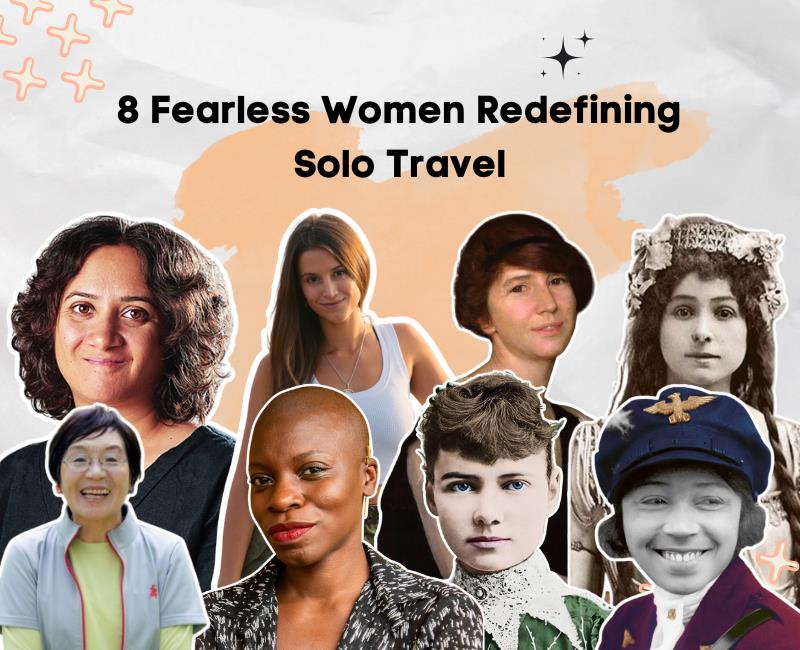
Below are some of the most remarkable women who’ve not only explored the world but also reshaped how we think about solo travel. Each one represents a different shade of bravery from those who walked into deserts with a compass and notebook to those who turned every border crossing into a story of resilience and purpose.
Freya Stark
Before solo travel was even a concept, Freya Stark was doing it. Born in 1893 in Paris and raised in Italy and England, she spent her twenties studying Arabic and Middle Eastern culture, which was a decision that would change her life forever. At a time when women were discouraged from traveling unaccompanied, she ventured deep into the deserts of Arabia, Iran, and Turkey with only a notebook and a sense of wonder.
Her journeys were far from easy. Stark travelled through dangerous tribal territories, often with minimal resources and little institutional support. She navigated illness, language barriers, and political tension, yet her determination never wavered. In her books, such as The Valleys of the Assassins and A Winter in Arabia, she didn’t romanticize her experiences at all. Instead, she stood true to her experiences and wrote about loneliness, fear, and fatigue, alongside the awe and beauty she found in human connection.
What made Stark revolutionary wasn’t just her courage but her curiosity. She didn’t travel to conquer or claim; she travelled to understand. Her writings introduced readers to cultures and landscapes that few Westerners had seen, and she did so with empathy and grace. Freya Stark showed generations of women that being alone should not be seen as a limitation or a disadvantage. See it as an invitation to explore the unknown on your own terms.
Junko Tabei
Junko Tabei’s story is one of pure persistence. Born in Japan in 1939, she grew up in a conservative society that believed women belonged at home, not on mountains. But from the moment she joined a climbing club at university, Tabei was hooked to the core. She faced constant criticism not just from society but from male climbers who often refused to take her seriously.
Although absolutely undeterred, Tabei founded the Ladies Climbing Club: Japan in 1969, giving women a platform to pursue mountaineering without prejudice. In 1975, she made history by becoming the first woman to reach the summit of Mount Everest. But inevitably, that climb was anything but smooth. During the expedition, an avalanche buried their camp, injuring several climbers, including Tabei. Still, she refused to give up. Days later, with a bruised body and an indomitable spirit, she stood at the top of the world.
Tabei didn’t stop there. She went on to climb the highest mountains on every continent known as the Seven Summits and dedicated her later life to environmental causes, while encouraging women to embrace adventure. Her philosophy was simple yet profound: “Do not give up. Keep on your quest.” Junko Tabei proved that physical endurance and inner resolve can break not only altitude records but also gender barriers.
Bessie Coleman
In the early 20th century, aviation was dominated by men. Yet Bessie Coleman, born in 1892 in Texas, had dreams that refused to stay on the ground. As a Black and Native American woman, she faced a double wall of discrimination in the United States. No flight school would accept her. But instead of giving up, she taught herself French, saved money, and traveled to Paris to earn her pilot’s license, becoming the first African American woman and the first Native American woman in the world to do so.
Her training in France opened doors that America had slammed shut. After returning home, she became a sensation, performing daring aerial stunts and encouraging others to challenge the impossible. But her mission was never just about fame. She wanted to create opportunities for people who looked like her, planning to open a flight school for Black pilots.
Though her life was cut short in a tragic crash at just 34, Bessie Coleman’s legacy continues to soar. Her courage flew beyond the clouds and defied every system that told her she couldn’t. Today, countless female pilots, especially women of colour, trace their inspiration back to her wings.
Nellie Bly
In 1889, when women were still expected to stay within the confines of home and decorum, Elizabeth Cochran Seaman, more popularly known by her pen name Nellie Bly, embarked on one of the most audacious journeys in history. A pioneering journalist for The New York World, she set out to travel around the world in under 80 days, inspired by Jules Verne’s novel Around the World in Eighty Days. Armed with just one small bag and her unwavering confidence, Nellie, much like all the women on this list, proved that women could do far more than society allowed them to imagine.
Her journey was seen as a battle against prejudice. Travelling through France, Japan, Hong Kong, and beyond, Bly encountered scepticism at nearly every port. Many doubted she would finish, but she did, completing the trip in just 72 days. Her reports captivated readers across America, making her one of the first female celebrities in journalism.
Her travels were a statement of defiance against Victorian ideals that confined women to domesticity. She turned a solo journey into a public triumph, proving that adventure and intellect were not the exclusive rights of men. To this day, she remains a symbol of fearless ambition, a woman who literally circled the world to change how it saw her gender.
Alexandra David-Néel
Before borders were easily crossed and maps were reliable, French explorer and writer Alexandra David-Néel pushed the limits of exploration and of what a woman could do in the early 1900s. Fluent in several languages and deeply interested in Eastern philosophy, she set out on a journey that would make her one of the most fascinating travellers of her time.
In 1924, disguised as a beggar and accompanied by a young monk, David-Néel became the first Western woman to enter the forbidden city of Lhasa, Tibet. At that time, foreigners were strictly banned, and the journey involved immense physical hardship like freezing temperatures, hunger, and the constant threat of being discovered.
What made her remarkable wasn’t just her daring disguise but her intellectual curiosity. She immersed herself in Buddhist teachings, living in monasteries and studying spiritual practices that only a few Westerners understood. The result of her brave journey to the unknown, her book My Journey to Lhasa captivated readers worldwide, blending adventure with philosophy and insight.
Alexandra David-Néel travelled for meaning. Her story remains one of courage balanced with wisdom, a reminder that exploration isn’t just about geography, but also about expanding the mind.
Jessica Nabongo
Fast forward to the twenty-first century, and solo travel looks very different, yet the spirit of women like Stark and Tabei lives on through travellers such as Jessica Nabongo. Born to Ugandan parents in Detroit, Jessica became the first Black woman to visit every country in the world, a journey that took her to all 195 nations by 2019.
Her motivation wasn’t just wanderlust. Jessica wanted to rewrite the narrative around who gets to travel and what a traveller looks like. Through her blog The Catch Me If You Can, she documented every little experience she came across from farmers, artisans, and local hosts, giving faces to the stories behind each destination.
Her travels often carried layers of meaning. She visited countries that many avoid due to political instability, showing the human side of places often defined by headlines. She also advocated for responsible travel and cultural respect, urging her audience to support local communities instead of exploiting them.
For Jessica, solo travel became activism. Her presence in every country was a message that women of colour can occupy any space, any border, and any dream. Her work continues to inspire a new generation of travellers who see representation not as a bonus, but as a necessity.
Shivya Nath
Shivya has a story everyone has fantasised about at least once in their lifetime while sitting at work in their offices. In 2011, Shivya Nath quit her corporate job in Singapore, sold most of her belongings, and set out to travel the world with just a backpack and a camera. What began as a short sabbatical became a lifestyle. Over the years, she’s lived in over 50 countries, often in remote villages, immersing herself in local cultures and traditions.
Unlike many travel influencers, Shivya’s journey is deeply rooted in sustainability. She advocates for responsible tourism, choosing to travel slow, support women-owned businesses, and reduce her carbon footprint. Her blog, The Shooting Star, has inspired thousands of young Indians to explore the world without waiting for the “right time.”
Shivya often writes about how solo travel helped her unlearn societal expectations and redefine independence. She’s candid about her fears and failures, making her story relatable to anyone contemplating a similar leap. In her bestselling memoir of the same name, she writes, “I travel to unlearn fear.” That sentiment perfectly captures her journey, which is not about ticking off countries but about connecting deeply with the planet and oneself.
Lexie Alford
When Lexie Alford became the youngest person to visit every country in the world at just 21, she set a new standard for modern exploration. Born in California, Lexie grew up around travel as her parents ran a travel agency, but her journey was entirely self-motivated.
Travelling through 196 countries required intense planning, from securing visas to navigating war zones. She funded her trips through savings, sponsorships, and freelance photography, showing that adventure doesn’t have to come with privilege.
Her experiences ranged from climbing volcanoes in the Congo to crossing the Arctic Circle. Yet, she often highlights the quiet moments like drinking tea with locals, sharing stories in small towns, and realising that kindness is a universal language. Lexie’s travels emphasise human connection over headline destinations, encouraging young women to see the world as both a classroom and a mirror.
Conclusion
Every woman who travels solo carries a story that could inspire another. Each flight taken, each fear faced, adds to a collective narrative of courage.
Fearless women around the world are redefining freedom itself. They’re showing that the world isn’t as scary as we’ve been told and that strength doesn’t mean never being afraid; it means going anyway.
So, if you’ve ever thought, “Maybe someday,” this is your sign. That someday could be now. Pack your bag, trust your instincts, and step into the unknown. The world is waiting, and it’s way less scary than you think.