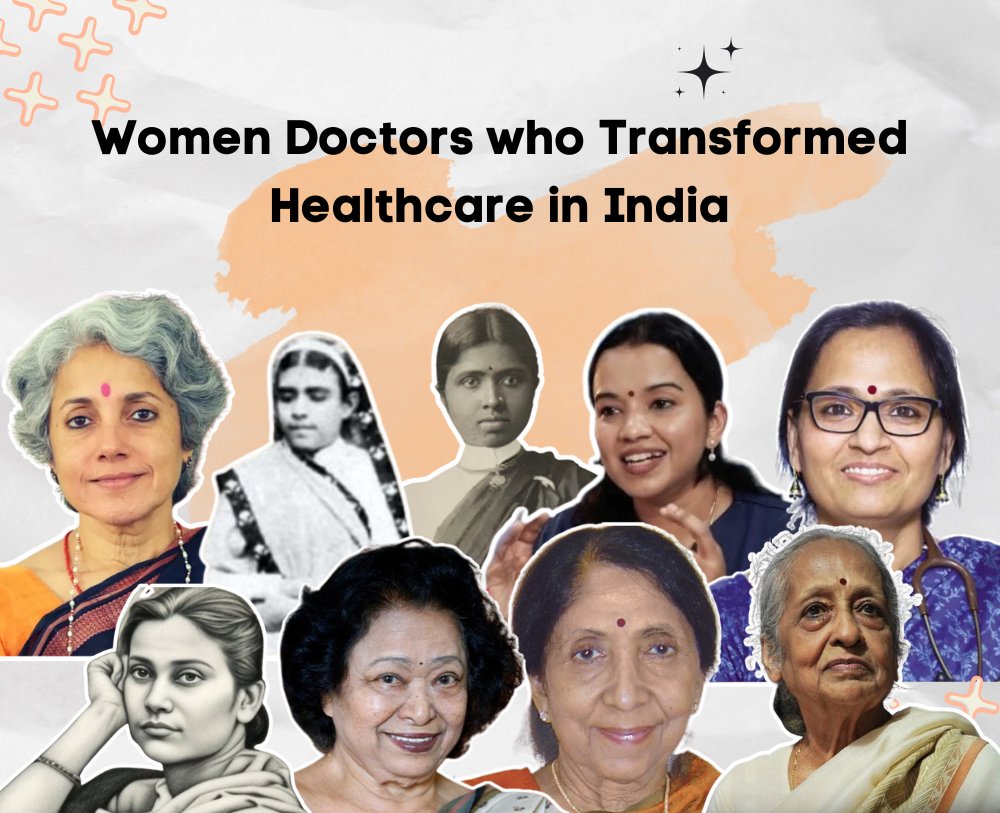
Women Doctors who Transformed Healthcare in India
Date: February 6, 2026
India’s healthcare story would be incomplete without the extraordinary contributions of women doctors. These are the women who, despite societal pressures, limited opportunities, and countless obstacles, chose to dedicate their lives to healing others. In India, women doctors have quietly rewritten the rules of healthcare, often fighting societal expectations just to step into clinics, hospitals, and operating rooms. They were daughters, wives, and mothers, yet they dared to dream bigger than what the world around them expected.
These women did not just treat patients, they transformed communities. They introduced new medical practices, championed women’s and children’s health, and opened doors for generations of women who thought medicine was beyond their reach. Their journeys are filled with struggle, hope, and unwavering compassion. Behind every white coat was a story of resilience, every stethoscope a promise to serve, and every small triumph a step toward a healthier, fairer society.
Dr. Kadambini Ganguly
Sivaramakrishna Iyer Padmavati, born in 1917, was India’s first woman cardiologist and a driving force behind modern heart care in the country. She dedicated her life to improving cardiac health at a time when specialized care for heart diseases was scarce. Dr. Padmavati served as the director of the National Heart Institute in Delhi and founded the All India Heart Foundation, establishing infrastructure and programs that continue to save countless lives today. She set up India’s first cardiac clinic and cardiac catheterization laboratory, creating the foundation for cardiology as a recognized and accessible specialty in India.
Her efforts were widely recognized, culminating in the Padma Vibhushan in 1992, India’s second highest civilian honor. She was also an elected fellow of the National Academy of Medical Sciences. Beyond accolades, Dr. Padmavati was known for her dedication to spreading awareness about heart disease and training the next generation of cardiologists. Her work transformed cardiology from a niche field into a critical part of India’s healthcare system. Through her expertise, vision, and compassion, Dr. Padmavati not only treated patients but also strengthened the medical landscape and inspired women to enter fields that were once considered male domains.
Dr. Soumya Swaminathan
Dr. Soumya Swaminathan is a globally recognized pediatrician and clinical researcher, known for her groundbreaking work in tuberculosis and HIV. Her career blends scientific rigor with a commitment to public health, making her one of the most influential figures in modern medicine. She served as the Chief Scientist at the World Health Organization from 2019 to 2022 and was previously Deputy Director General of Programmes. In these roles, she helped shape global health policies, emphasizing the importance of evidence-based approaches to prevent and treat disease.
Her research has resulted in over 350 peer-reviewed publications and numerous book chapters. Beyond research, Dr. Swaminathan advocates for translating scientific findings into practical interventions, ensuring that knowledge benefits communities worldwide. She currently chairs the M S Swaminathan Research Foundation, where she continues to advance public health and education. Through her work, she demonstrates how science and empathy can combine to improve lives. Dr. Swaminathan’s journey shows that leadership in medicine is not just about knowledge but also about using it to create tangible, positive change for people everywhere.
Dr. Indira Hinduja
Dr. Indira Hinduja is a pioneering figure in reproductive medicine in India, transforming the lives of countless couples facing infertility. She played a central role in developing in-vitro fertilization and assisted reproductive technologies at a time when reproductive health was still a sensitive and stigmatized subject. Her efforts not only helped patients conceive but also opened broader conversations about fertility and women’s health in India.
Her approach combines technical skill with deep empathy. Patients often remember her for the encouragement, patience, and care she provides alongside medical expertise. Dr. Hinduja’s work has made fertility treatments accessible and acceptable, inspiring other doctors to innovate in reproductive medicine. She continues to advocate for women’s health and reproductive rights, demonstrating that medical breakthroughs are most meaningful when they are human-centered. Through her dedication, she has shown that courage, knowledge, and compassion can transform deeply personal aspects of life, giving hope and joy to families across the country.
Dr. Rupa Bai Furdoonji
Dr. Rupa Bai Furdoonji holds the distinction of being the world’s first female anesthetist, graduating in 1889. Practicing in Hyderabad, she entered a field that was in its infancy and almost entirely male-dominated. Despite societal constraints and skepticism, she mastered anesthesia, providing safe surgical care at a time when it was experimental and risky.
Her work had a profound impact on the medical community, demonstrating that women could excel in technical and high-responsibility roles. She inspired subsequent generations of female anesthetists in India and abroad. Beyond her technical achievements, Dr. Furdoonji’s determination challenged social norms and expanded the possibilities for women in medicine. Her legacy is one of skill, courage, and the quiet persistence to pursue excellence in an era when few women had the opportunity. She remains a symbol of pioneering spirit, proving that barriers can be broken when dedication and talent converge.
Dr. Muthulakshmi Reddy
Dr. Muthulakshmi Reddy was a visionary physician, social reformer, and advocate for women’s health in the early 20th century. Born in 1886 in Madras, she became one of the first women to earn a medical degree in India. She dedicated her career to improving maternal and child health, particularly for marginalized women who lacked access to proper care. Beyond medicine, Dr. Reddy worked tirelessly to fight social evils such as child marriage and exploitation of women, believing that public health and social reform were inseparable.
She played a key role in establishing the Adyar Cancer Institute in Chennai, providing specialized care and fostering research in oncology. Dr. Reddy also became the first woman legislator in India, advocating for laws that promoted women’s welfare and health rights. Her work reflected a deep understanding that medicine could not function in isolation from society. Dr. Reddy’s legacy is a testament to the impact one woman can have when she combines professional expertise with social conscience. She inspired future generations of women doctors to see healthcare not only as a profession but as a platform for societal change.
Dr. Aruna Ramachandra
Dr. Aruna Ramachandra is a prominent figure in the field of pediatric neurology in India. Over the last few decades, she has made significant contributions to diagnosing and treating neurological disorders in children. Her work focuses on early detection, intervention, and rehabilitation, aiming to improve the quality of life for children with complex conditions such as cerebral palsy, epilepsy, and developmental delays.
Beyond her clinical work, Dr. Ramachandra has been a mentor and trainer, guiding young pediatricians and neurologists in understanding the nuances of child neurology. She has also been active in raising public awareness about neurological disorders, emphasizing the importance of early treatment and inclusive care. Her approach combines scientific rigor with empathy, ensuring families feel supported throughout often challenging medical journeys. Dr. Ramachandra’s dedication illustrates how women doctors in specialized fields can transform healthcare for vulnerable populations while inspiring the next generation of medical professionals to pursue excellence in care and compassion.
Dr. Shakuntala Devi (Medical Advocate)
While popularly known for her mathematical genius, Dr. Shakuntala Devi’s work in healthcare advocacy has often been overlooked. She championed mental health awareness in India long before it became a mainstream conversation. Working with hospitals, schools, and community organizations, she promoted early diagnosis and treatment of mental health conditions, particularly among children and women.
Dr. Devi believed in the power of knowledge and education to destigmatize medical conditions. She developed workshops and public campaigns that combined science with empathy, helping families and communities understand mental health challenges. Her efforts opened doors for women and marginalized groups to access care without shame. Through her work, she highlighted the importance of holistic health combining physical, mental, and social wellbeing and demonstrated how women in medicine and advocacy could change societal attitudes alongside improving medical outcomes.
Dr. V. Shanta
Dr. V. Shanta dedicated her life to oncology, changing the landscape of cancer treatment in India. Born in 1927 in Chennai, she joined the Adyar Cancer Institute and eventually became its chairperson, transforming it into one of India’s leading cancer care centers. Dr. Shanta focused on providing affordable treatment, especially for women and children who could not otherwise access specialized care.
Her work extended beyond treatment to education and awareness. She emphasized early detection, patient counseling, and public outreach, ensuring that communities understood cancer prevention and care. Dr. Shanta was recognized nationally and internationally, receiving the Padma Bhushan and Padma Shri awards for her contributions. Despite her accolades, she remained deeply committed to patients, often spending long hours offering guidance and comfort.
Dr. Shanta’s legacy lies not only in the lives she saved but in the compassionate model of care she established. She showed that excellence in medicine requires both technical skill and human empathy. Through her decades of service, she inspired countless women to pursue careers in oncology and demonstrated how one person’s dedication could transform a field and touch thousands of lives.
Dr. Sushma Bhatnagar
Dr. Sushma Bhatnagar is a leading oncologist and palliative care specialist whose work has changed cancer treatment in India. She has been a pioneer in integrating palliative care into mainstream oncology, ensuring that patients receive not only medical treatment but also emotional and psychological support. Her holistic approach recognizes the importance of quality of life alongside medical intervention.
Beyond clinical care, Dr. Bhatnagar has trained doctors across the country in palliative medicine, spreading awareness about end-of-life care and compassionate treatment. She has also worked on policy initiatives to improve access to pain relief and specialized care for patients in rural and underserved areas. Her dedication illustrates how women doctors can combine expertise with advocacy to make a systemic impact. Dr. Bhatnagar’s work emphasizes that medicine is not only about curing diseases but also about caring for the person as a whole.
Dr. Hemalata Balakrishnan
Dr. Hemalata Balakrishnan is an influential public health physician who has focused on maternal and child health in India. Through her research and community programs, she has helped reduce maternal mortality and improve neonatal care in underserved regions. She has collaborated with government and non-government organizations to implement strategies that make healthcare more accessible and effective.
Her approach combines data-driven strategies with on-the-ground community engagement. Dr. Balakrishnan believes that sustainable healthcare improvements require understanding local culture, educating families, and empowering women. She has mentored young medical professionals, especially women, to pursue careers in public health and preventive medicine. Her work exemplifies how leadership, compassion, and scientific rigor can intersect to create meaningful change. By addressing systemic challenges, she has helped shape the health of countless communities and inspired a generation of women to pursue careers that impact public well-being.
Impact of Women in Medicine
Women doctors have transformed healthcare in India in ways that go far beyond treating patients. They have challenged social norms, opened doors for other women, and expanded access to medical care in communities that were previously underserved. By establishing clinics, hospitals, and specialized care centers, they created infrastructure that benefits millions of people every day.
Their influence extends into education, mentorship, and public health advocacy. Many have trained the next generation of doctors, nurses, and healthcare workers, ensuring that knowledge and expertise are passed on. Others have worked on awareness campaigns, policy reforms, and research initiatives that address critical health issues such as maternal and child health, heart disease, infectious diseases, and mental health.
The presence of women in medicine has also changed the way care is delivered. Their focus on empathy, communication, and patient-centered approaches has improved experiences for countless patients, particularly women and children. By balancing clinical skill with compassion, these doctors have made healthcare more accessible, inclusive, and humane. The collective impact of women in medicine demonstrates that representation matters, and that their leadership continues to shape the future of healthcare in India.
Conclusion
The stories of these extraordinary women doctors show that healthcare is shaped not just by knowledge and skill, but by courage, determination, and compassion. From pioneers like Kadambini Ganguly and Rupa Bai Furdoonji to modern leaders such as Dr. Soumya Swaminathan and Dr. Indira Hinduja, each woman has left an enduring mark on medicine in India. These doctors have shown that one person’s vision and dedication can ripple outward, touching thousands of lives and inspiring others to follow in their footsteps. Their legacy is a reminder that when women lead with knowledge, empathy, and perseverance, healthcare becomes more inclusive, compassionate, and effective. They have changed India’s medical landscape, and their work continues to inspire future generations to dream, challenge boundaries, and make a lasting difference.