13 Women Trailblazers in STEM Fields
Date: January 29, 2026
For a long time, science and technology were seen as men’s territory. Women were told they lacked the intellect or the discipline needed to work in laboratories, lecture halls, or observatories. Many were denied formal education or dismissed as assistants, even when their discoveries reshaped the world. Yet history tells another story. Women have always been in STEM (science, technology, engineering, and mathematics). They worked quietly, often without recognition, and in many cases their contributions only came to light years later.
Today, more girls are entering STEM classrooms than ever before. Coding bootcamps, research labs, and space programs now have more women’s names on the door. Still, the playing field is far from even. Women remain underrepresented in top positions, face gaps in pay, and often struggle with biases that question their authority. This makes it all the more important to remember the women who fought the hardest battles. They are not only historical figures but also role models, showing that persistence, imagination, and courage can change the course of science.
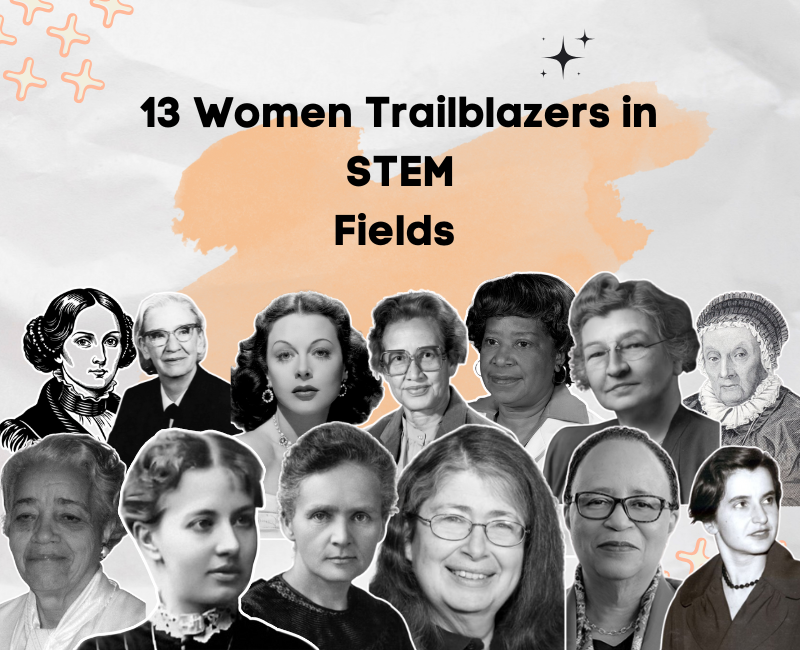
This article celebrates those trailblazers, past and present, who helped shape STEM.
The Road to Recognition
The history of women in STEM is not just about achievements but also about how hard it was to get those achievements recognized. For centuries, women who showed talent in science or mathematics were told their curiosity was “unfeminine.” In the 1700s, universities in Europe and America simply did not admit women. Those who wanted to learn often had to rely on private tutors or sneak access to books. Even when a woman managed to study, she was rarely allowed to publish under her own name.
Take the example of Sophie Germain, a French mathematician who contributed to number theory and elasticity. Because the École Polytechnique in Paris refused to enroll women, she borrowed lecture notes from male students. When she began corresponding with famous mathematician Carl Friedrich Gauss, she used the pseudonym “Monsieur LeBlanc.” Only later did Gauss discover that the brilliant mind behind the letters was a woman.
In astronomy, Caroline Herschel discovered comets and catalogued stars, yet her work was overshadowed by her brother William, who was celebrated as the King’s Astronomer. Caroline was eventually recognized with a modest salary and later awarded the Royal Astronomical Society’s Gold Medal, but much of her life’s work was attributed to men.
The same pattern repeated in the 20th century. Women were hired as “computers,” expected to perform calculations but not to lead projects or claim authorship. At NASA, brilliant women like Katherine Johnson and Dorothy Vaughan were segregated by race and gender, their offices tucked away in corners. In genetics, Rosalind Franklin’s DNA research was used without her knowledge by colleagues who went on to receive a Nobel Prize.
Beyond institutional barriers, there were societal pressures. Women were told that their primary duty was to marry and raise children. Pursuing science often meant being labeled unfeminine or selfish. Many worked unpaid or in their husbands’ laboratories, contributing to discoveries that were published under male names.
1. Ada Lovelace
One of the earliest women to challenge boundaries was Ada Lovelace. In the early 1800s, she collaborated with Charles Babbage on his design for the Analytical Engine, a mechanical computer that was never built. While Babbage focused on engineering, Ada grasped its deeper potential. In her notes, she described how the machine could manipulate symbols, compose music, and perform beyond arithmetic. She even wrote the first algorithm meant for a machine to execute.
At a time when mathematics was closed off to women, Lovelace’s imagination stretched into what would eventually become computer science. Today, she is hailed as the world’s first programmer, proof that women were present at the very birth of the digital age.
2. Marie Curie
Born in Warsaw in 1867, Marie Curie grew up in a world where women were barred from formal scientific education. Determined, she moved to Paris and enrolled at the Sorbonne, where she immersed herself in physics and mathematics. Alongside her husband Pierre, she began experimenting with uranium, which led to the discovery of two new elements: polonium and radium.
Her groundbreaking research on radioactivity was more than just a scientific triumph. It gave medicine new tools, from cancer treatments to X-ray machines, and opened an entirely new branch of physics. In recognition, Curie became the first woman to win a Nobel Prize, and later the only person in history to win Nobel Prizes in two different sciences. Her dedication came at a cost. Years of exposure to radiation slowly damaged her health, yet she never abandoned her work. She even designed mobile X-ray units during World War I to help soldiers on the battlefield. Today, Marie Curie is remembered not only as a scientist of extraordinary brilliance but as a pioneer who proved that intellectual excellence has no gender.
3. Hedy Lamarr
In the 1940s, Hollywood knew Hedy Lamarr as a dazzling actress, but behind the glamour was a mind that refused to sit still. Born in Austria and later moving to America, Lamarr’s curiosity stretched far beyond film sets. During World War II, she collaborated with composer George Antheil to design a frequency-hopping communication system. Their idea was to stop enemies from jamming radio-controlled torpedoes.
The world did not immediately recognize the genius of her invention. For decades, her patent lay buried, dismissed in part because no one took an actress seriously as a scientist. Yet her concept of spread spectrum technology became the foundation for Wi-Fi, Bluetooth, and GPS. Long after her film career ended, Lamarr finally received acknowledgment as a true innovator. Today, she is remembered not only for her beauty but as proof that brilliance often hides in unexpected places.
4. Rosalind Franklin
Rosalind Franklin’s laboratory in the 1950s was filled with sharp X-ray images that few could decipher. Among them was the now-famous “Photo 51,” a diffraction pattern of DNA that revealed its helical structure. Franklin, a chemist and crystallographer, was meticulous in her work, piecing together the secrets of life one photograph at a time.
Her discovery, however, was taken without her knowledge and handed to James Watson and Francis Crick, who went on to publish the DNA double helix model and later won the Nobel Prize. Franklin never received the same recognition during her lifetime, but her role is now firmly established. She also made important contributions to virus research, leaving behind work that stretched beyond DNA. Franklin’s story is one of brilliance overshadowed, a reminder of how easily women’s contributions were erased from history.
5. Katherine Johnson
In the tense days of the space race, when the world looked to the stars, Katherine Johnson was the quiet force who made math work. Born in 1918 in West Virginia, she was a gifted child who loved numbers. At NASA, Johnson became part of the group of African American women mathematicians known as “human computers.”
When John Glenn prepared to orbit Earth, he trusted Johnson more than the new electronic machines. “Get the girl to check the numbers,” he said, and she calculated trajectories with flawless precision. Later, she contributed to the Apollo missions, helping land men on the Moon. Her journey was not only about mathematics but also about breaking racial and gender barriers in one of the most exclusive scientific institutions. Today, Katherine Johnson stands as a symbol of intellect, perseverance, and courage, finally celebrated after years in the shadows.
6. Mary Jackson
Mary Jackson’s career began at a time when both race and gender placed firm ceilings on what a woman could achieve. Born in 1921 in Virginia, she joined NASA in the segregated West Area Computing section, where African American women worked separately from their white colleagues. Yet Jackson’s talent could not be confined to the margins. She became an engineer, specializing in aerodynamics, testing models in supersonic wind tunnels, and improving aircraft designs.
To gain her engineering credentials, she had to petition the city of Hampton for permission to take night classes at a white-only high school. She succeeded and went on to become NASA’s first Black female engineer. Later in her career, she turned her focus to mentoring, using her position to open doors for women and minorities in science. Mary Jackson’s life is remembered not only for her technical achievements but also for the way she fought to make space for others.
7. Dorothy Vaughan
When Dorothy Vaughan joined NASA in 1943, she entered a world where women were called “computers” and expected to serve silently in the background. But Vaughan quickly proved she was more than a calculator. She rose to lead the West Area Computing Unit, managing a group of African American women mathematicians whose work was essential to NASA’s missions.
As the agency shifted toward electronic computers, Vaughan taught herself programming in FORTRAN and ensured her team stayed ahead of the curve. This foresight allowed her colleagues to remain indispensable during a time of change. She became NASA’s first Black supervisor, a trailblazer who combined technical brilliance with leadership. Dorothy Vaughan’s legacy is one of quiet strength and vision, showing how adaptability and mentorship can shape history.
8. Edith Clarke
Born in 1883, Edith Clarke was fascinated by numbers and machinery at a time when engineering was almost entirely a male preserve. After earning her degree in mathematics, she worked as a human computer for AT&T before pursuing graduate studies. In 1919, she became the first woman to earn a master’s degree in electrical engineering from MIT.
Her real impact came in the field of power transmission. Clarke developed mathematical methods that allowed engineers to predict the behavior of electrical lines, making long-distance transmission more efficient and reliable. She later became the first female professor of electrical engineering in the United States. Her career was defined by breaking barriers, not only in technical innovation but in showing that women could stand at the very heart of modern engineering.
9. Sophie Germain
In late 18th-century Paris, Sophie Germain pursued mathematics against every social convention. Women were not admitted to universities, so she borrowed lecture notes and submitted work under a male pseudonym, “Monsieur LeBlanc.” Her perseverance brought her into correspondence with the great mathematician Carl Friedrich Gauss, who recognized her genius once her identity was revealed.
Germain made significant contributions to number theory and elasticity theory, fields that underpin both pure mathematics and practical engineering. Her work on vibrations in elastic surfaces laid the foundation for modern structural engineering. Despite facing lifelong dismissal by institutions, she won a prize from the French Academy of Sciences for her work on elasticity, a rare acknowledgment of a woman’s intellect in that era. Sophie Germain remains a figure of defiance, proving that intellect will find a way even when the doors of academia are locked.
10. Caroline Herschel
Caroline Herschel’s journey into astronomy began as an assistant to her brother William, who discovered Uranus. Yet her own talent soon shone. Born in Germany in 1750 and later moving to England, she began cataloguing the night sky with a keen eye and relentless patience. Over her career, she discovered eight comets and recorded thousands of stars, helping to refine the astronomical maps of her time.
Though overshadowed by her brother for much of her life, Caroline eventually won recognition as the first woman to receive a salary for scientific work in Britain. She was later awarded the Gold Medal of the Royal Astronomical Society another first for a woman. Herschel’s life is a reminder that supporting roles can blossom into groundbreaking contributions, and that persistence can carve a woman’s name into the stars.
11. Shirley Ann Jackson
Shirley Ann Jackson’s story is one of brilliance carved against the weight of history. Born in Washington, D.C. in 1946, she showed an early aptitude for science and mathematics. In the 1960s, when racial and gender divides were still sharp, Jackson entered the Massachusetts Institute of Technology. There she became the first African American woman to earn a PhD in theoretical physics from MIT, an achievement that made her a pioneer twice over.
Her research focused on subatomic particles, but her influence extended far beyond the lab. Jackson later chaired the U.S. Nuclear Regulatory Commission, where she balanced scientific rigor with public safety. As president of Rensselaer Polytechnic Institute, she transformed the university into a global hub of innovation. Jackson’s journey shows that leadership in STEM is not just about scientific discovery but also about reshaping institutions to reflect diversity and vision.
12. Radia Perlman
Often called the “Mother of the Internet,” Radia Perlman’s work is the invisible backbone of how the modern world connects. Born in 1951, she studied computer science at MIT and later developed the Spanning Tree Protocol, a breakthrough that allowed computer networks to scale and communicate reliably. Without her invention, the internet that we can’t live without could not exist.
Perlman’s contributions went beyond technical brilliance. She also created child-friendly programming languages and has been a lifelong advocate for making computer science accessible to everyone. Despite her central role in networking, she often downplays her title, emphasizing that the internet is the product of many hands. Her humility only deepens the respect she commands as one of the architects of our digital world.
13. Grace Hopper
Grace Hopper had a knack for turning the abstract into the practical. Born in 1906, she served in the U.S. Navy during World War II and went on to become one of the most influential figures in computer science. Hopper created the first compiler, a tool that translated human-friendly instructions into machine code. This breakthrough paved the way for COBOL, one of the earliest high-level programming languages still influencing systems today.
She was also a natural teacher, famous for her witty demonstrations and her insistence that programming should be accessible. Hopper coined the term “debugging” after removing an actual moth from a malfunctioning computer. Her career blended military discipline with academic curiosity, and she eventually rose to the rank of rear admiral. Grace Hopper’s legacy lies in making computers usable not just for specialists but for everyone, bringing technology closer to human hands.
The Present
Today, women are no longer confined to the sidelines of science and technology. They are professors, inventors, CEOs, astronauts, and AI leaders shaping the future. Universities around the world now actively encourage women to enter STEM fields, and mentorship programs connect young girls with role models who look like them. Initiatives such as Girls Who Code, Code First Girls, and Women in STEM scholarships are making what was once unthinkable a reality: classrooms and labs filled with women tackling some of the world’s hardest problems.
Yet, challenges remain. Women are still underrepresented in top positions, and pay gaps persist in many industries. Bias, whether subtle or systemic, continues to discourage many talented young women from pursuing careers in science or staying in the long term. The pandemic also highlighted how easily women’s careers can be disrupted by disproportionate caregiving responsibilities.
At the same time, the digital revolution has created opportunities that previous generations never imagined. Artificial intelligence, renewable energy, biotechnology, and space exploration are fields expanding faster than ever, and women are at the heart of these revolutions. Leaders like Fei-Fei Li in AI or Elizabeth Blackburn in genetics show that the future of science is not just male or female it is human, shaped by diverse perspectives working together.
Conclusion
The journey of women in STEM has been long, uneven, and filled with barriers, yet also marked by brilliance that refused to be silenced. From Ada Lovelace imagining a programmable machine in the 1800s, to Katherine Johnson calculating the path to the Moon, to modern innovators leading breakthroughs in AI and genetics, women have always been part of the story. The future, if we continue to open doors and break ceilings, will be one where the phrase “women in STEM” is not a category but simply the norm.