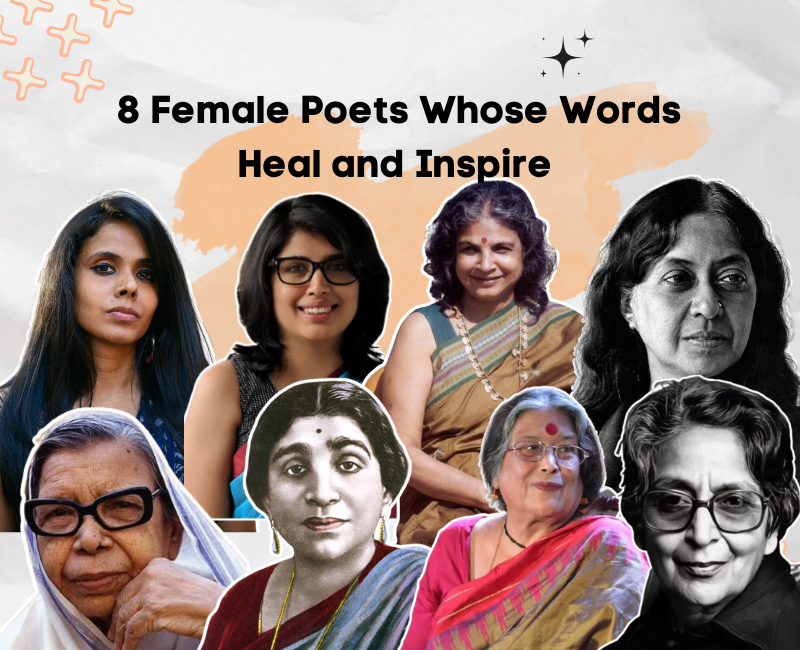
8 Female Poets Whose Words Heal and Inspire
Date: March 13, 2026
Poetry is not medicine, it’s an X-ray. It shows the wound and helps you understand it.” This truth, voiced by poet Dunya Mikhail, captures why poetry matters. It doesn’t just decorate language; it cuts deep, heals, and transforms.
In India, women poets have used this power to challenge silence, confront injustice, and inspire generations. Research from the University of Exeter shows that reading poetry activates brain regions associated with memory and self-reflection, which explains why verses often feel so personal.
Indian women, from Sarojini Naidu and Amrita Pritam to Kamala Das and Meena Kandasamy, have used poetry as a vehicle for optimism, truth-telling, and resistance.
This article highlights eight poets whose words continue to heal wounds and spark courage. Their work is more than literature; it’s a record of resilience and a guide for the future.
1. Mahadevi Verma
Mahadevi Verma (1907–1987) is a towering figure in Hindi literature, a leading poet of the Chhayavaad (Romanticism) era. Often hailed as the “Modern Meera,” her poetry is a confluence of profound sorrow, spiritual longing, and a deep connection with nature.
Born in Farrukhabad, Uttar Pradesh, Verma’s life was a testament to intellectual independence and artistic pursuit. She was a prolific writer, a freedom fighter, and an educator who dedicated her life to empowering women.
Her Poetic Universe
Verma’s poetry is characterized by its lyrical quality and its exploration of the soul’s yearning for the divine. Her work, though seemingly melancholic, is imbued with a spiritual optimism.
She masterfully employs metaphors from nature, such as the moon, clouds, and a lamp, to represent the soul’s journey and its quest for ultimate truth.
Her poems often express a unique brand of pain, a sacred sadness that is not about suffering, but about the beautiful ache of separation from the divine beloved.
Healing and Inspiration
Verma’s words offer a profound sense of healing by validating sorrow. In a world that pressures us constantly to be happy, she shows us the beauty and dignity of grief.
Her poetry inspires introspection and encourages a deeper understanding of our own emotional landscapes.
For anyone who has felt the pang of loneliness or the ache of unfulfilled desire, her verses are a comforting embrace, reminding us that even in our darkest moments, there is a path to a higher spiritual plane.
She inspires us to find beauty in sadness and to see our own pain as a part of a larger, sacred journey.
Key Works
- Yama (1940)
- Neerja (1934)
- Sandhyageet (1938)
2. Sarojini Naidu
Sarojini Naidu (1879–1949), fondly known as “The Nightingale of India,” was a multifaceted genius: a poet, a freedom fighter, and a political leader.
Born in Hyderabad, her poetic talent was recognized early, and she went on to write some of the most cherished works in Indo-Anglian literature.
Her poetry is a vibrant celebration of India’s cultural richness, its landscapes, and its people. It is a world of bustling bazaars, blooming gardens, and passionate love.
Her Poetic Universe
Naidu’s poetry is a testament to her keen observation and her lyrical prowess. Her verses are a sensory experience, painting vivid images with rich, evocative language.
She writes of the bustling markets, the vibrant colors of festivals, and the quiet dignity of everyday life. Her poems on love and nature are filled with a romantic passion that is both tender and fierce.
Healing and Inspiration
Naidu’s words heal by restoring a sense of beauty and wonder to the mundane. She reminds us to find joy in the simple moments, the song of a vendor, the scent of jasmine, the sound of a river. Her poetry serves as a powerful antidote to cynicism, inspiring us to view the world with a fresh, appreciative eye.
As a woman who fearlessly navigated the male-dominated worlds of politics and literature, she stands as an icon of empowerment, inspiring generations to find their voice and use it to fight for justice and freedom. Her life, much like her poetry, was a vibrant song of resistance and hope.
Key Works
- The Golden Threshold (1905)
- The Bird of Time (1912)
- The Broken Wing (1917)
3. Amrita Pritam
Amrita Pritam (1919–2005) was a legendary Punjabi poet and novelist, a trailblazer whose work fearlessly explored themes of love, partition, and the plight of women.
Born in Gujranwala (now in Pakistan), she witnessed the harrowing violence of the 1947 partition firsthand, and her most iconic poem, Ajj Aakhaan Waris Shah Nu (I Say to Waris Shah Today), became an anthem for the tragedy.
Her Poetic Universe
Pritam’s poetry is raw, honest, and deeply personal. It is a stark contrast to the romanticism of her contemporaries. She writes of the pain of separation, the complexities of human relationships, and the yearning for freedom, both personal and societal.
Her work challenges patriarchal norms and speaks of a love that transcends societal boundaries and legal contracts.
Healing and Inspiration
Pritam’s words heal by giving voice to the voiceless. Her poetry validated the pain and suffering of millions who were displaced and traumatized by the partition.
She brought their stories of loss and resilience into the mainstream, creating a space for collective mourning and healing. Her fearlessness in addressing taboo subjects, especially those related to female sexuality and identity, is a source of immense inspiration.
She inspires us to be unapologetically ourselves, to love with a fierce passion, and never to shy away from speaking our truth, no matter how uncomfortable it may be for others.
Key Works
- Ajj Aakhaan Waris Shah Nu (1947)
- Sunehade (1955)
- Kagaz Te Canvas (1970s)
4. Kamala Das
Kamala Das (1934–2009), also known by her pen name Madhavikutty, was a revolutionary poet who wrote in both English and Malayalam.
She is considered a pioneer of the confessional poetry movement in India, a writer who bared her soul with an unflinching honesty that shocked and captivated readers.
Her work is a bold exploration of female identity, sexuality, and the restrictive nature of patriarchal society.
Her Poetic Universe
Das’s poetry is characterized by its raw, unfiltered voice. She breaks away from traditional poetic forms and conventions, writing with a directness that feels almost like a personal conversation.
Her work is deeply introspective, exploring the complexities of her own desires, her struggles with marital life, and her search for a genuine sense of self in a world that sought to define her.
Healing and Inspiration
Kamala Das’s words heal by normalizing the very things that society tells us to hide. Her poetry gave a voice to the inner turmoil and unfulfilled desires of countless women, letting them know they were not alone in their struggles.
She inspires us to confront our own truths, no matter how difficult they may be, and to live authentically.
Her courageous exploration of her own body and mind, her defiance of societal expectations, and her unwavering commitment to her art make her a powerful symbol of liberation and self-acceptance.
Key Works
- Summer in Calcutta (1965)
- The Descendants (1967)
- The Old Playhouse and Other Poems (1973)
5. Eunice de Souza
Eunice de Souza (1940–2017) was a Goan poet, novelist, and literary critic known for her sharp wit and her incisive observations of urban life.
Her poetry is a departure from the grand themes of her predecessors, focusing instead on the mundane, the awkward, and the subtly painful aspects of everyday existence.
She writes of Mumbai’s chaotic streets, the ironies of middle-class life, and the struggle to find meaning in a seemingly meaningless world.
Her Poetic Universe
De Souza’s poetry is characterized by its minimalist style and its biting humor. She employs a precise, spare language to craft powerful images and convey small, poignant stories.
Her work is often satirical, gently mocking the social hypocrisies and gender roles she saw around her. She finds beauty not in the grand, romantic gestures, but in the quiet moments of loneliness and the resilience of the human spirit.
Healing and Inspiration
De Souza’s words heal by providing a sense of camaraderie in our shared vulnerabilities. Her poetry makes us feel seen, validating our everyday anxieties and frustrations. She inspires us to find humor in our own struggles and to see the dignity in our ordinariness.
In a culture that often demands grand narratives, she reminds us that a life well-lived is a collection of small, honest moments. Her wit and her unflinching honesty are a source of inspiration, encouraging us to be a little less severe and a lot more authentic.
Key Works
- Fix (1979)
- Ways of Belonging (1990)
- A Necklace of Skulls (2009)
6. Meena Kandasamy
Meena Kandasamy (born 1984) is a contemporary Indian poet, activist, and writer known for her fierce and unapologetic voice. Her work is a powerful critique of caste, patriarchy, and political injustice. She uses poetry as a weapon, a tool to expose the brutal realities of a society riddled with inequality and oppression.
Her Poetic Universe
Kandasamy’s poetry is marked by its raw power and its political urgency. She writes with a directness that is both shocking and necessary, using vivid imagery to describe the violence and discrimination she sees around her.
Her work is a call to action, a demand for justice, and a testament to the resilience of those who fight for their rights.
Healing and Inspiration
Kandasamy’s words heal by empowering the marginalized. She gives a voice to those who have been silenced, their stories of suffering and resistance finally being heard.
Her poetry inspires a fierce sense of justice, encouraging us to be more than just passive observers of injustice. She teaches us that speaking truth to power is not only a moral duty but also a powerful form of healing.
Her bravery in confronting complex subjects and her unwavering commitment to her cause make her an inspiring figure for a new generation of activists and writers.
Key Works
- Touch (2006)
- Ms. Militancy (2010)
- The Illicit Happiness of Other People (2019)
7. Nabaneeta Dev Sen
Nabaneeta Dev Sen (1938–2019) was a celebrated Bengali writer and poet, known for her witty, conversational style and her playful yet profound exploration of modern womanhood.
Her work is a delightful blend of the personal and the philosophical, filled with humor, warmth, and a deep understanding of human relationships.
Her Poetic Universe
Dev Sen’s poetry feels like a heart-to-heart conversation with a wise and funny friend. She writes about the everyday dilemmas of a modern woman, love, marriage, motherhood, and the quest for intellectual freedom.
Her verses are free-flowing and unpretentious, capturing the subtle nuances of emotion and the complexities of domestic life with a light touch.
Healing and Inspiration
Dev Sen’s words heal by bringing a sense of lightness and perspective to life’s struggles. Her poetry reminds us that it’s okay to laugh at ourselves and our problems.
She encourages us to appreciate our relationships, find joy in the ordinary, and face life’s obstacles with a healthy dose of self-awareness and a sense of humor. Her celebration of womanhood in all its messy, glorious complexity is a source of immense inspiration.
She teaches us that a woman can be both a scholar and a homemaker, a poet and a friend, and that there is beauty and wisdom in all of it.
Key Works
- Swayang Pradhana (1972)
- Moner Katha (1987)
- Bhalobasha Moner Modhye (1990)
8. Sumana Roy
Sumana Roy is a contemporary Indian writer and poet whose work is deeply rooted in the natural world. Her poetry is a quiet, meditative exploration of the relationship between humans and nature, a gentle reminder of the interconnectedness of all living things.
She finds poetry in the rustling of leaves, the quiet dignity of trees, and the small, forgotten moments of nature.
Her Poetic Universe
Roy’s poetry is characterized by its lyrical prose and its profound sense of stillness. She writes with a precision that makes you feel as if you are standing right beside her, observing the world with a new sense of reverence.
Her work often blurs the lines between the human and the non-human, inviting us to see ourselves as part of a larger ecosystem, not as its masters.
Healing and Inspiration
Roy’s words heal by re-establishing our connection with the natural world. In a world of constant noise and distraction, her poetry is a balm for the soul. She inspires us to slow down, to pay attention, and to find solace in the simple beauty of nature.
Her work reminds us that we are not alone, that we are part of a vast and ancient web of life, and that there is immense healing to be found in that connection. She teaches us to be more mindful, more present, and to find our own quiet place in the world.
Key Works
- My Father’s Garden (2019)
- Out of Syllabus (2014)
The Final Thought
Even in the era of rapid social media updates and dynamic content, poetry remains a timeless art form. And among its most powerful practitioners are the female poets of India, who have used words not only to tell their stories but to give countless others the courage to tell theirs.
Their poetry heals us when we are wounded, inspires us when we feel powerless, and reminds us that words can change both the self and the world.
As Sarojini Naidu once wrote, poetry is “the voice of the soul.” These poets prove that when women lend their voices, they do not just sing; they resonate across generations.