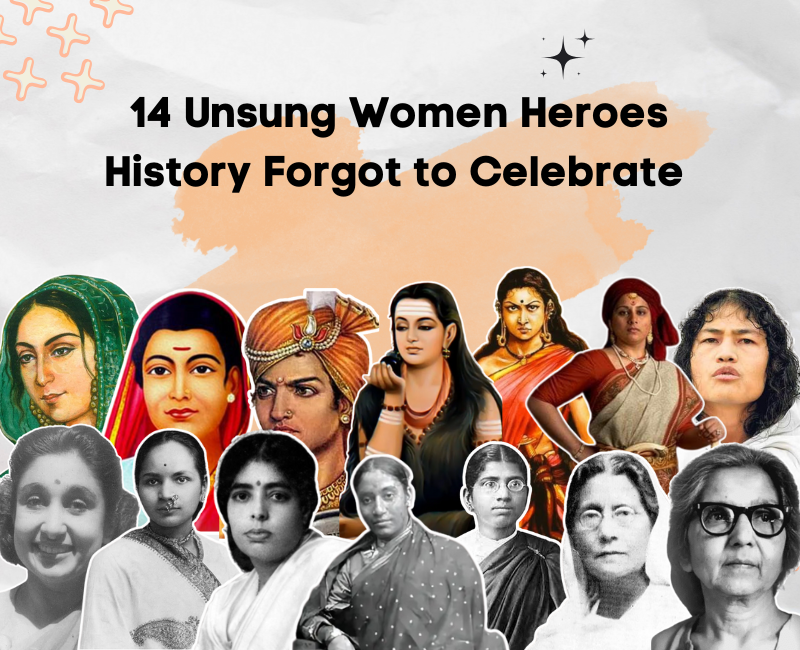
14 Unsung Women Heroes History Forgot to Celebrate
Date: December 29, 2025
Indian history often highlights kings, saints, and freedom fighters, primarily men. But behind the pages are women whose contributions shaped India’s culture, politics, and freedom struggles, yet remain largely forgotten.
Research shows that less than 10% of historical references in Indian school textbooks mention women, despite their crucial roles as reformers, warriors, and leaders. True strength was demonstrated by women such as Lopamudra, the Vedic scholar; Jhalkari Bai, who participated in the 1857 uprising; and Savitribai Phule, who pioneered women’s education.
Mahatma Gandhi once said, “When the woman, whom we call abala (weak), becomes sabala (strong), all those who are helpless will become powerful.” His words remind us that the nation’s progress has always depended on its women, even when history failed to record their names.
This article shines a light on these unsung women heroes of India, whose courage and vision deserve to be remembered alongside the most celebrated figures of our past.
Freedom Fighters and Warriors
The fight for India’s independence was not just a man’s struggle. Women from all walks of life, from queens to ordinary villagers, took up arms and defied the British Raj. Their courage and sacrifice were instrumental in fueling the nationalist movement.
1. Rani Velu Nachiyar
Rani Velu Nachiyar was the first Indian queen to successfully fight and defeat the British East India Company, long before the more well-known Rani of Jhansi.
Born in 1730 in Tamil Nadu, she was trained in martial arts, swordsmanship, and archery from a young age. She was also a polyglot, fluent in several languages, including English, French, and Urdu.
After her husband, the King of Sivaganga, was killed in a battle with the British, Velu Nachiyar was forced into exile. For eight years, she meticulously planned her comeback, forming an alliance with Hyder Ali, the ruler of Mysore, and building a formidable army.
Her intelligence and strategic genius were on full display when she launched a surprise attack on the British forces. One of her most notable achievements was the creation of a women’s army, the Udaiyaal, named in honor of her daughter.
In 1780, she led her army to victory, reclaiming her kingdom. She is also credited with inventing the first human bomb, a method in which her loyal commander, Kuyili, covered herself in oil and set herself ablaze, walking into a British ammunition depot to destroy it.
2. Begum Hazrat Mahal
While the story of the 1857 Indian Rebellion is often told through the lens of figures like Mangal Pandey and the Rani of Jhansi, Begum Hazrat Mahal, the queen of Awadh, was one of its central leaders.
A fierce patriot, she assumed control of the state’s affairs after her husband, Nawab Wajid Ali Shah, was exiled by the British.
When the rebellion broke out, she led her followers and personally commanded her troops, fighting the British with remarkable ferocity.
She successfully recaptured Lucknow and declared her son as the new king. Begum Hazrat Mahal’s resilience and leadership were so formidable that the British were forced to commit a massive military effort to defeat her.
Even after a prolonged siege, she refused to surrender, eventually seeking refuge in Nepal. Her unwavering resistance and organizational skills made her a symbol of defiance against colonial rule; however, her role is often overshadowed by that of her male counterparts in historical accounts.
3. Savitribai Phule
In the mid-19th century, when women’s education was a radical and often dangerous idea, Savitribai Phule emerged as a relentless champion for the rights of women and Dalits.
Along with her husband, Jyotirao Phule, she opened India’s first school for girls in 1848 in Pune. She faced unimaginable opposition, with people throwing stones and cow dung at her as she walked to school.
Undeterred, she carried a spare sari to change into and continued her mission. She later opened eighteen schools for females and was instrumental in the founding of the first Dalit school.
Savitribai was not just an educator; she was a social reformer, a poet, and a feminist who fought against child marriage, sati, and caste discrimination. Her relentless pursuit of equality laid the groundwork for modern education and social reform in India.
4. Kamini Roy
Born in 1864, Kamini Roy was a feminist poet, social worker, and the first woman in British India to graduate with an Honours degree in Sanskrit.
She was a fearless advocate for women’s right to vote and labor rights. She famously wrote, “Why do women stay at home and do men’s jobs?” a revolutionary question for her time.
Her work went beyond the literary world. She led the charge to secure voting rights for women in Bengal, which was finally achieved in 1926.
Kamini Roy used her poetry and influence to challenge patriarchal norms and advocate for a society where women had agency and voice. Her contributions to literature and the women’s suffrage movement are monumental, yet her name is rarely mentioned in mainstream historical narratives.
5. Aruna Asaf Ali
Firebrand activist Aruna Asaf Ali was instrumental in the fight for Indian independence. She rose to fame during the Quit India Movement in 1942, when all of the main leaders were taken into custody.
On August 9, 1942, she hoisted the Indian tricolor flag at the Gowalia Tank Maidan in Mumbai, defying the British authorities.
She went underground for several years, leading the movement from the shadows and publishing a monthly underground newspaper to keep the spirit of rebellion alive.
The British declared a reward for her capture, but she was a master of disguise and evasion. Her courage and resourcefulness made her a symbol of the young, defiant India.
Although she continued to be involved in politics and social work after independence, her crucial contribution to the Quit India Movement is frequently disregarded in favor of more well-known male leaders.
6. Muthulakshmi Reddy
Muthulakshmi Reddy was a trailblazer who broke countless glass ceilings in the early 20th century. Born in 1886, she was the first female doctor to graduate from the Madras Medical College. She went on to become the first woman legislator in British India in 1927.
Her relentless fight marked her time in the legislature for women’s rights and social justice. She was instrumental in passing legislation to abolish the Devadasi system, prohibit child marriage, and establish homes for destitute women and orphans.
She also founded the Cancer Institute in Chennai, one of the first of its kind in India. Dr. Reddy’s contributions to public health and social reform are immeasurable; however, her legacy is not widely known outside of academic circles.
7. Rukhmabai
Rukhmabai was a pioneering physician and feminist who challenged societal norms in the late 19th century.
She is considered to be one of the first practicing female doctors in British India. Her story gained national attention when she refused to live with her husband, whom she had been married to since childhood.
The ensuing legal battle, known as the Rukhmabai case, became a landmark in the fight against child marriage.
The case sparked a significant debate about social reform, and her defiance inspired many women to challenge patriarchal traditions. With the support of reformers and philanthropists, she went to England to study medicine, graduating in 1894.
Upon her return, she worked as a doctor for over three decades, providing crucial healthcare services to women and children.
Her personal struggle and professional achievements made her a symbol of female emancipation. Still, her story serves as a powerful reminder of the hidden battles fought by many women in pursuit of their dreams.
8. Janaki Ammal
E.K. Janaki Ammal was a world-renowned botanist and cytogeneticist whose work was crucial to India’s agricultural development.
Born in 1897, she was one of the few women to pursue higher education in the sciences in her era. She earned a doctorate from the University of Michigan and conducted groundbreaking research on sugarcane genetics.
Her work contributed to the development of a new strain of sugarcane that was better adapted to Indian conditions, thereby significantly enhancing the country’s sugar production.
She also worked on the genetics of a variety of other plants, including eggplants and magnolias. She was a fierce environmentalist who spoke out against the destruction of forests for hydroelectric projects.
Despite her immense scientific contributions, she remains an obscure figure in a field dominated by male scientists.
9. Irom Chanu Sharmila
The “Iron Lady of Manipur,” Irom Chanu Sharmila, is a contemporary heroine who battled injustice in silence. The Armed Forces (Special Powers) Act (AFSPA), which granted the army broad authority to search, detain, and even shoot to kill, prompted her to launch a hunger strike in 2000.
Her hunger strike lasted for 16 years, making it the longest hunger strike in the world. She was arrested and force-fed through a nasal tube for the duration of her protest.
Sharmila’s unwavering commitment to her cause, despite the physical and mental torment, brought international attention to the human rights issues in her state.
While she is not entirely unsung, her story of sustained, nonviolent protest against a powerful state apparatus is a testament to the incredible strength of a single individual fighting for justice.
10. Rani Abbakka Chowta
Long before the British became a dominant power, the Portuguese were expanding their influence along India’s western coast. But they met their match in Rani Abbakka Chowta, the queen of Ullal (near Mangalore, Karnataka).
Abbakka was the first woman freedom fighter who fiercely resisted Portuguese colonization in the 16th century. She mobilized her navy, used guerrilla warfare, and built alliances with neighboring rulers.
What’s striking is her ability to unite Hindus, Muslims, and even local communities against a common enemy.
Despite repeated attacks, Abbakka defended her kingdom valiantly, earning the title of the “first woman freedom fighter of India.” Sadly, her story is rarely highlighted in our classrooms, though locals in Karnataka still honor her memory.
11. Akkamahadevi
Centuries before women poets gained recognition, Akkamahadevi emerged as a spiritual leader and poet in Karnataka. She became one of the most prominent figures in the Bhakti movement, known for her devotion to Lord Shiva.
Akkamahadevi rejected societal norms, renounced her marriage, and lived as a wandering saint. Her vachanas (poetic compositions) spoke of freedom, spiritual love, and the futility of materialism.
Her courage to stand against patriarchy and express herself openly through poetry makes her one of the earliest feminist voices of India.
12. Uda Devi
While Rani Lakshmibai is celebrated as a heroine of 1857, Uda Devi, a Dalit woman warrior, is often forgotten.
Uda Devi organized a women’s battalion and fought the British forces during the Battle of Sikandar Bagh in Lucknow. In one of the most heroic moments, she is said to have climbed a tree and shot down nearly 30 British soldiers before being killed.
Her bravery demonstrated that the fight for freedom was not limited to royals or elites, but also included Dalit women warriors, whose voices were erased from mainstream history.
13. Anandibai Joshi
In the 19th century, when women barely had access to education, Anandibai Joshi broke barriers by becoming the first Indian woman to study medicine abroad.
At just 19 years old, she sailed to the U.S. and earned her medical degree in 1886. Anandibai’s decision was revolutionary, especially considering the social stigma against women pursuing education and traveling overseas.
Though she died young, her story opened doors for future generations of women in medicine in India.
14. Captain Lakshmi Sahgal
One of the most iconic but less celebrated figures of India’s freedom struggle is Captain Lakshmi Sahgal.
As a close associate of Subhas Chandra Bose, she led the Rani of Jhansi Regiment of the INA, an all-women’s battalion formed to fight against British colonial rule.
Even after independence, Lakshmi continued her service as a doctor and social activist, working for refugees, the poor, and marginalized communities. Her life is a powerful reminder that the struggle for freedom did not end in 1947 but continued through service and social justice.
Conclusion
History often silences women. Their voices are drowned in patriarchal narratives, their achievements erased, their stories forgotten. But by revisiting the lives of Rani Abbakka Chowta, Velu Nachiyar, Savitribai Phule, Anandibai Joshi, Rani Gaidinliu, and many others, we keep their legacies alive.
The next time we celebrate freedom fighters, reformers, or visionaries, let’s not forget these Indian women heroes that history ignored. They deserve to be remembered, not just as footnotes, but as central figures in the story of India.
Because if history forgot them, it’s our responsibility to celebrate them.