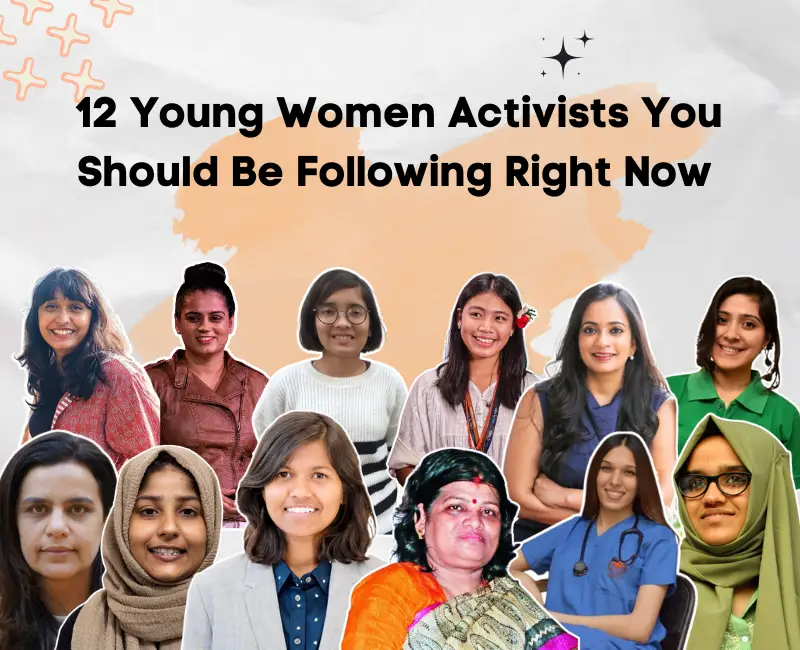
12 Young Women Activists You Should Be Following Right Now
Date: December 5, 2025
India is at a crossroads today. The country is grappling with economic inequalities, climate vulnerabilities, gender-based violence, and digital misinformation, all while housing one of the world’s youngest populations. Young women sit at the heart of this transition.
They bring a lived experience of navigating patriarchy while embracing education, technology, and global networks. Their activism comes from everyday battles, be it resisting societal expectations, dealing with unsafe streets, or confronting systemic discrimination. By challenging narratives from within their communities, they embody a courage that feels both personal and political.
This isn’t activism confined to rallies or closed-door meetings. Today’s young Indian women are turning Instagram feeds into classrooms, Twitter threads into protests, and YouTube channels into community networks. Their courage lies not just in speaking up but in refusing to be silenced. They tackle issues ranging from climate change and gender justice to caste equity and LGBTQ+ rights. If you want to understand the pulse of youth-driven movements in India, following these young women activists is the best place to start.
Ridhima Pandey
If you think teenagers cannot change global conversations, Ridhima Pandey will make you reconsider. Hailing from Uttarakhand, she was only nine when she filed a petition at the National Green Tribunal against the Indian government for failing to act on climate change. Since then, her journey has been nothing short of inspiring.
Ridhima has spoken at international forums, including the United Nations Climate Action Summit, alongside global icons such as Greta Thunberg. Her activism highlights how climate change is no distant problem but rather a lived reality for millions in India who face floods, droughts, and erratic weather patterns every year. She uses her platform to amplify the voices of those in vulnerable communities, reminding policymakers that climate action cannot wait and is detrimental to nurturing the coming generations while safeguarding the present.
What makes Ridhima’s activism powerful is her ability to merge youthful urgency with hard facts. She doesn’t rely on just emotional appeal; she brings data, local experiences, and global solidarity into her arguments. Following her will keep you updated on India’s climate struggles and the fresh perspective of a generation that will inherit the consequences of today’s decisions.
Disha Ravi
Disha Ravi’s name became a household conversation in 2021 when she was arrested for editing and sharing a farmers’ protest “toolkit.” The incident sparked nationwide outrage and global solidarity, but beyond the headlines lies the story of a determined climate activist from Bengaluru.
Disha co-founded the Indian chapter of “Fridays for Future,” a youth-led movement pushing for urgent climate action. Her focus has often been on how climate justice is linked to social justice, especially for farmers and marginalized communities, who are the first to bear the brunt of ecological collapse.
What stands out about Disha is her refusal to be intimidated, even when facing state machinery. She continues to write, organize, and campaign, demonstrating that activism isn’t about grand speeches alone but about persistence in the face of adversity.
Aysha Renna
During the protests against the Citizenship Amendment Act (CAA) in 2019-2020, one image went viral where a young woman in a hijab stood fearlessly in front of armed police, raising her finger in resistance. That young woman was Aysha Renna.
As a student activist from Jamia Millia Islamia, Aysha became a symbol of defiance. Along with her peers, she mobilized thousands to demand equal rights and question discriminatory laws. Her activism followed the path of organizing peaceful demonstrations, reading circles, and conversations that built community solidarity.
What makes Aysha’s presence important is how she represents the intersection of youth, faith, and constitutional values. She shows that activism can be rooted in identity while also transcending it, uniting diverse groups under a shared demand for justice.
Yogita Bhayana
When it comes to addressing gender-based violence, Yogita Bhayana has been one of the most persistent voices. Founder of the “People Against Rape in India” foundation, she has worked extensively with survivors of sexual assault and their families.
Though she is slightly older than some others on this list, Yogita’s inclusion is vital because her activism resonates deeply with younger women. She demonstrates how advocacy doesn’t end at raising slogans but also includes providing legal, emotional, and financial support to survivors. Her campaigns push for stricter laws, better implementation, and a culture that listens to women rather than silencing them.
By following her, you gain a window into how young women can lead movements that combine compassion with political willpower.
Manasi Pradhan
While Manasi Pradhan is already an established name in women’s rights advocacy, her current work mentoring young activists makes her particularly relevant in this context. Through her “Nirbhaya Vahini” initiative, she trains young women to become leaders in their own communities.
She approaches her activism by empowering girls with tools to address challenges specific to their environment, rather than imposing set-in-stone strategies that won’t help someone whose situation is entirely different from the rest. To do this, she includes self-defense workshops, policy training, and grassroots organizing to ensure that young women understand activism as both a right and a responsibility.
Her inclusion in this list reminds us that the story of young women activists is also about intergenerational solidarity. Following her gives you insights into how mentorship sustains movements over time.
Aarushi Batra
Co-founder of the Robin Hood Army, Aarushi Batra started her journey in her early twenties. The organization redistributes surplus food from restaurants to those in need. What began as a small effort has now spread across multiple countries, feeding millions while inspiring youth to volunteer.
Aarushi’s activism is particularly interesting because it shows how social media can be used for genuine impact. Instead of just trending hashtags, her campaigns mobilize real people to take real action in their neighborhoods. She represents a model of activism that is scalable, community-driven, and deeply practical. Following her means learning how digital savvy can merge with old-school volunteering to create sustainable solutions.
Afreen Fatima
Afreen Fatima, a student leader and activist, has emerged as a bold voice for Muslim women in India. Known for her work in student politics, she has spoken out against discriminatory laws and systemic Islamophobia. What makes her activism striking is the way she combines sharp analysis with personal storytelling, offering an unflinching look into what it means to live with layered marginalizations.
Her speeches and writings are critiques of policies but call for collective awakening as well. She urges people to see connections between caste, gender, and religion, challenging India to reckon with its diversity honestly. Following Afreen gives you insight into how activism rooted in lived experience can still speak to the universal need for dignity and justice.
Rhea Singhal
Activism doesn’t always have to look like protests on the streets. Some of it happens in labs, hospitals, and policy rooms. Rhea Singhal, founder of Ecoware and a champion of sustainable health solutions, is a reminder that activism can take entrepreneurial forms.
Rhea turned her fight against plastic waste into a business model that produces biodegradable tableware. This innovation is not only environmentally friendly but also helps reduce long-term health hazards caused by single-use plastics. While she often identifies as a social entrepreneur, her work intersects with activism because it addresses structural problems through innovation.
For young women watching her journey, Rhea proves that fighting for change doesn’t always mean holding a placard; it can also mean inventing alternatives that reshape everyday living.
Trinetra Haldar Gummaraju
Representation matters, and Trinetra Haldar Gummaraju has become one of the most recognizable faces of India’s transgender community. A doctor by training and a content creator by choice, she uses her platform to break myths about gender identity and healthcare.
Trinetra’s activism is deeply personal yet widely impactful. She shares her transition journey, challenges the medical system’s biases, and advocates for LGBTQ+ rights in a country where acceptance is still a struggle. Through videos, blogs, and collaborations, she makes conversations about queerness more accessible, especially for young Indians who may feel alone in their identities.
Following her not only educates you about LGBTQ+ rights but also normalizes the presence of trans voices in mainstream spaces, which is activism at its most transformative.
Licypriya Kangujam
When you think of child prodigies, you might imagine math whizzes or chess players. But Licypriya Kangujam chose to take on climate change instead. At just eight years old, she was already addressing global leaders and demanding urgent climate action.
From marching outside parliament in Delhi to speaking at international conferences, Licypriya has been relentless in pushing for climate literacy in schools and strong environmental laws. She represents the youngest wave of activists, whose urgency comes from the realization that they may not even have a livable planet if adults fail to act now.
Her activism is refreshing because it strips away political jargon and goes straight to the point. “Save the Earth for our future” may sound simple, but when spoken by a child holding a placard, it becomes impossible to ignore.
Poorna Malavath
At the age of 13, Poorna Malavath became the youngest Indian girl to climb Mount Everest. While her feat was celebrated globally, what makes her story powerful is how she turned that victory into activism. Coming from a marginalized community in Telangana, Poorna now works to inspire other underprivileged girls to dream beyond societal expectations.
She advocates for education, adventure sports, and opportunities for girls who are often told to stay within the confines of tradition. Her activism is about breaking psychological barriers as much as physical ones, showing that young women can literally move mountains when given a chance.
Following her will give you daily doses of courage, reminding you that activism sometimes begins with proving to yourself that nothing is impossible.
Srishti Bakshi
Though often mentioned together, Srishti Bakshi stands out as a young woman activist who walked 3,800 kilometers across India to raise awareness about women’s safety. Her campaign, “CrossBow Miles,” was not just a walk but a movement. Along her journey, she conducted workshops on digital literacy, self-defense, and financial independence for women in rural areas.
Srishti’s activism shows the importance of visibility. By walking across states, she brought media and community attention to issues that are often brushed aside as “private matters.” Her energy, determination, and refusal to normalize harassment make her one of the most dynamic young activists to follow.
Why Following These Women Matters
It’s easy to scroll past a headline or feel overwhelmed by the sheer number of issues in today’s world. Yet following these young women activists offers something more than just updates. It gives you access to raw courage, unfiltered stories, and practical blueprints for change. They remind us that activism isn’t abstract; it is deeply human, deeply local, and deeply urgent.
They also prove that activism doesn’t look the same for everyone. For some, it’s standing in front of armed forces with nothing but conviction. For others, it’s designing menstrual hygiene workshops, organizing climate strikes, or redistributing food. This diversity is precisely what makes the current wave of Indian women activists so refreshing.
Conclusion
The women we’ve explored are reminders that courage is contagious. Their journeys prove that activism doesn’t need to wait until you’re older, wealthier, or more “qualified.” It can begin with a single act of filing a petition, starting a workshop, posting a video, or simply speaking out. These young women activists carry the torch of change, lighting up paths for others who may have thought their voices didn’t matter.
In their stories, you’ll find lessons on persistence, creativity, empathy, and above all, the power of youthful courage. They are shaping India’s future in real time, and the least we can do is pay attention.