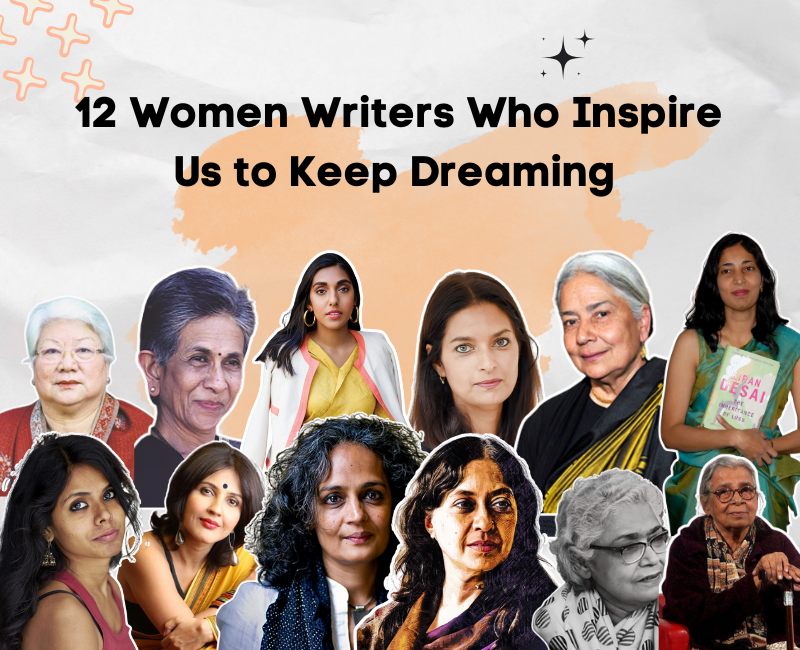
12 Women Writers Who Inspire Us to Keep Dreaming
Date: January 12, 2026
Stories are bridges. They connect worlds, emotions, and dreams that sometimes feel out of reach. For many of us, the first spark of imagination came from the words of a writer who dared to put their thoughts on paper. In India, a country with layered histories and vibrant voices, women writers have played a powerful role in shaping how we dream, resist, and grow. Their words are like seeds of courage, mirrors of lived experience, and sometimes, gentle reminders that possibilities are endless.
When we read their novels, essays, or poems, we find stories that reflect our struggles and hit a chord within us to keep marching forward regardless of any obstacle that comes our way. They remind us that imagination has no boundaries and that our dreams are worth chasing, even when the world tells us otherwise. In this piece, we’ll explore some of the most inspiring women writers from India whose words continue to push us toward bigger dreams, deeper empathy, and fearless living.
Arundhati Roy
Arundhati Roy is not just a novelist. She is a voice that insists on being heard. Her debut novel, The God of Small Things, won the Booker Prize in 1997, showing the world the immense potential in her pen. It opened a window into Kerala’s lush landscape, while also exposing caste, love, and family secrets with raw honesty. For many readers, Roy’s prose felt like poetry dressed in rebellion.
But her journey did not stop with fiction. Roy became an essayist and activist whose words challenged governments, corporations, and even global powers. She wrote about dam projects, war, democracy, and freedom with sharp clarity. Her essays remind us that a writer’s role is not limited to storytelling, but also to holding power to account.
Roy inspires us to keep dreaming by showing that one can blend creativity with courage. Her work whispers to aspiring writers that their stories matter, and words are enough to stir both hearts and revolutions.
Kamala Das
Kamala Das, also known famously by her pen name Madhavikutty, dared to write what many women of her time only thought in private. Her poetry and autobiographical work My Story shattered social taboos by speaking openly about female desire, loneliness, and identity.
In a society that often demanded silence from women, Das wrote with unapologetic honesty. Her words stripped away masks and invited readers into the rawness of human emotions. Critics called her bold, but readers called her liberating. For countless women, she gave language to feelings they had buried deep within.
Her journey teaches us that dreams don’t always have to be about grandeur. Sometimes, dreaming is about claiming the right to be fully yourself. Kamala Das inspires dreamers by reminding us that authenticity is the most radical form of courage.
Mahasweta Devi
Mahasweta Devi’s approach to writing never aimed to entertain. It was meant to awaken people to the realities of society. Through works like Draupadi and Hajar Churashir Ma, she told the stories of tribal communities, dispossessed women, and exploited laborers in India. Her words gave dignity to people whom society often overlooked.
She was as much of a tireless activist as a prolific author. She worked on the ground to fight for tribal rights. What makes Mahasweta Devi remarkable is how she blended literature and activism seamlessly. Reading her almost felt like an intellectual exercise, but it was also an emotional confrontation with injustice.
Her work inspires us to dream of a more equal world. She reminds us that literature has the power to change not only how we think but also how we act. For anyone with a pen and a conscience, she proves that stories can become weapons of hope.
Anita Desai
If you have been fortunate enough to come across Anita Desai’s writing, then you might have experienced what it feels like to enter a delicate art painting. Unlike writers who chase dramatic plots, Desai focuses on the quieter corners of existence. Her novels, including Clear Light of Day and In Custody, dwell on the inner lives of characters who wrestle with silence, longing, and memory.
Through her, we learn that dreams sometimes are whispers. She shows that introspection, imagination, and subtle emotions are equally powerful. Her style has inspired countless young writers to embrace nuance instead of spectacle.
Anita Desai has also nurtured future voices through her teaching career, encouraging new generations to find confidence in their creativity. She inspires us to keep dreaming gently, patiently, and with attention to the small details that make life meaningful.
Kiran Desai
Kiran Desai, daughter of Anita Desai, carved her own place in the literary world with The Inheritance of Loss, which won the Man Booker Prize in 2006. Her work paints vivid portraits of migration, globalization, and the struggle between tradition and modernity. While her mother’s writing was quiet and introspective, Kiran Desai brought sharper edges to questions of class, colonial memory, and belonging.
Her journey is inspiring because it shows how creativity can travel across generations without losing individuality. She teaches us that dreams can be inherited, transformed, and passed on, each version becoming its own story. Her success reminds younger writers that even in a globalized world, rooted stories from India have the power to resonate across continents.
Jhumpa Lahiri
Although Jhumpa Lahiri was born in London and raised in the United States, her roots in India deeply shape her storytelling. Works like Interpreter of Maladies and The Namesake explore the immigrant experience, identity, and the tug of belonging to two worlds.
Her prose is crisp yet lyrical, and her characters wrestle with the contradictions of migration, family, and cultural memory. Lahiri herself became a symbol of reinvention when she began writing in Italian, stepping into an unfamiliar language with the same grace she had in English.
Her story teaches us that dreaming often means embracing reinvention. She shows us that identity is not a fixed box but a canvas you can paint and repaint. For anyone torn between cultures, her words offer comfort and the courage to dream across borders.
Ismat Chughtai
Ismat Chughtai’s stories stirred storms in Urdu literature. With sharp wit and fearless themes, she confronted subjects like female sexuality, class struggles, and societal hypocrisy. Her short story Lihaaf became legendary, sparking debates and even legal battles for its candid portrayal of desire.
Chughtai was not afraid to face criticism or censorship. She believed that silence was more dangerous than scandal. Her rebellious energy still fuels young writers who want to challenge the status quo.
She inspires dreamers by proving that literature can be a battlefield where honesty triumphs over fear. Through her, we learn that dreaming often requires breaking rules and defying traditions.
Shashi Deshpande
Shashi Deshpande’s novels, like That Long Silence, delve into the everyday realities of middle-class Indian women. She portrays characters caught between tradition and modernity, duty and desire. Her storytelling does not rely on extraordinary events but on the quiet struggles of ordinary lives.
What makes her work inspiring is how she shows the courage of women who dream in small but significant ways. Her characters remind us that resilience can exist even within the walls of routine.
Deshpande teaches us that literature doesn’t have to be about extraordinary heroes. Sometimes, it can be about ordinary women who find extraordinary strength in the middle of everyday life. Her writing tells us that every dream, no matter how modest, matters.
Temsula Ao
Temsula Ao, a poet and ethnographer from Nagaland, used her words to highlight the stories of India’s Northeast. Her collections, like These Hills Called Home, bring out the pain, resilience, and cultural richness of her people.
For a long time, the voices of the Northeast were either ignored or misrepresented in mainstream Indian literature. Ao’s work corrected that silence. She documented oral traditions, explored memory, and created space for identities that had long been marginalized.
Her work inspires dreamers to believe that their roots, however small or remote they may seem, hold value and beauty. She reminds us that dreams are often found in reclaiming heritage and giving voice to the unheard.
Anuja Chauhan
Anuja Chauhan has been called the queen of contemporary Indian romance and comedy. With novels like The Zoya Factor, Those Pricey Thakur Girls, and Baaz, she creates worlds that are full of wit, sparkle, and relatability. Her characters are spirited, flawed, and endlessly fun to follow.
What makes Chauhan inspiring is how she breaks the myth that meaningful writing must always be heavy. She proves that dreams can bloom in laughter, banter, and quirky love stories. She has opened doors for a new generation of readers who once thought literature was intimidating. Her books are like a reminder that storytelling is meant to connect, not to alienate.
Through her success, we learn that dreaming also means embracing joy and refusing to apologize for being entertaining.
Meena Kandasamy
Meena Kandasamy is a poet, translator, and activist whose writing shakes readers out of complacency. Her works, including When I Hit You and Exquisite Cadavers, confront caste, gender violence, and political oppression with unflinching honesty. Her voice is fierce, lyrical, and unapologetically political.
She inspires because she uses her pen as a weapon of resistance. In a world where women are often asked to soften their tone, Kandasamy writes with sharp edges. For young dreamers, she is proof that words can spark movements and that poetry can be as powerful as protest.
Rupi Kaur
While Rupi Kaur is widely recognized as a Canadian poet, her Punjabi roots connect deeply with Indian identity. Her minimalist poetry collections, Milk and Honey and The Sun and Her Flowers, opened new avenues for Instagram-era literature. In India, countless young women found their own voices through her bite-sized verses.
She inspires because she showed that poetry doesn’t need to be complicated to be powerful. Her success opened doors for Indian poets experimenting with digital platforms, proving that the dream of being read doesn’t have to wait for a publishing house.
Conclusion
What’s truly magical is how their words spill into our lives in quiet ways. You might pick up a book on a lazy Sunday and suddenly find a line that stays with you for years. Or you might scroll past a poem online and realize it put into words something you’ve been feeling all along. That’s the secret power of these women: they turn small moments into lifelong sparks.
So if there’s one thing to take away, it’s to keep reading them, keep listening to them, and most importantly, keep writing your own story. Because somewhere, someone might need your words just as much as you once needed theirs. And that’s how the dream keeps passing forward, one page, one poem, one heart at a time.