12 Women Who Are Saving the Planet in Their Own Ways
Date: December 12, 2025
The planet is facing some serious problems, like climate change, pollution, rising temperatures, and loss of natural resources. Even in India, the effects of these changes are clearly visible. Hotter summers and unpredictable rains are affecting farmers, air pollution is choking cities, rivers are drying up, and forests are shrinking.
In the middle of these struggles, many Indian women are stepping forward to protect the Earth in their own unique ways. They are planting trees, cleaning rivers, creating eco-friendly businesses, and inspiring communities to live more sustainably.
These women prove that real change doesn’t always need huge resources or international recognition. It begins with passion, commitment, and the belief that every small effort can help heal the planet.
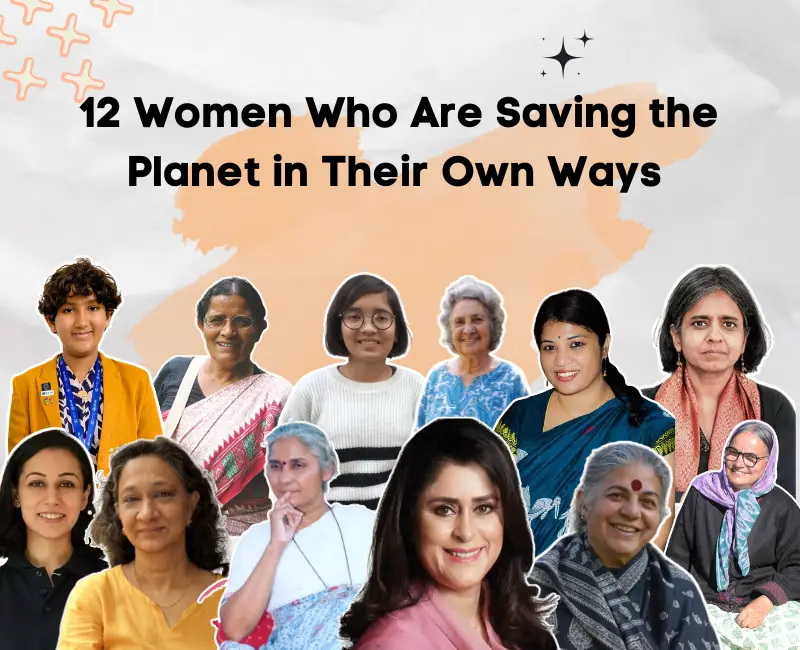
In this blog, we will share 12 remarkable women saving the planet in their own ways. Their stories remind us that real change often starts with ordinary people who care deeply about the world around them.
Medha Patkar – River and Land Protector
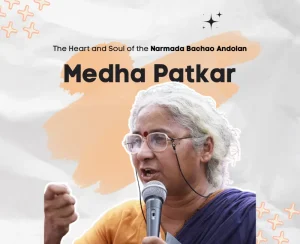
Medha Patkar is an Indian Social activist who is working on a range of issues from tribals and dalits to farmers, laborers, and women facing injustice. Besides all that, what got her on the list of women who are saving the planet is her Narmada Bachao Andolan.
Medha Patkar is the founding member and face of Narmada Bachao Andolan. It is a movement against large dams on the Narmada River that threaten to displace thousands and damage ecosystems. She fought peacefully for Adivasis, farmers, and others who were losing their homes and land without proper rehabilitation.
Her movement aimed for fair resettlement, sustainable development, and questioning harmful dam projects. Because of her efforts, thousands of displaced families received land-based rehabilitation, and the issues of displacement and environmental damage gained national attention.
Latika Nath – India’s “Tiger Princess”
Latika Nath is an Indian author, photographer, and one of India’s first female wildlife biologists and conservationists. She studied wildlife conservation at Oxford University, where her groundbreaking research on tiger ecology and behavior set her apart in a field long dominated by men.
Over the years, Latika has become a passionate advocate for India’s wildlife and natural ecosystems. Her conservation efforts extend beyond tigers to include elephants, snow leopards, and other endangered species. She has also joined hands with tribal communities to reduce human-wildlife disputes.
Latika Nath has even advised national and international organizations such as IUCN, UNDP, UNFPA, and ICIMOD on environmental and wildlife issues. Beyond research, Nath raises awareness through photography and storytelling, helping people connect emotionally with India’s wildlife. Her efforts support better wildlife management and conservation policies across India’s national parks.
Neha Juneja – Clean Energy Innovator
Neha Juneja is a social entrepreneur and co-founder of Greenway Grameen Infra. It is a company that is transforming the way rural households in India cook their meals. Basically, in many Indian villages, people still use mud stoves that produce thick smoke that harms both health and the environment.
Recognizing this problem, Juneja designed affordable, energy-efficient cookstoves that dramatically reduce smoke emissions and fuel consumption. By using Greenway’s improved stoves, families now breathe cleaner air and need less firewood, which reduces deforestation and carbon emissions.
The company has sold around 8 lakh biomass stoves made of steel and aluminum. These stoves produce 70% less smoke and use 50% less fuel compared to traditional mud stoves, reaching families across India and South America. By combining smart business with compassion, she is cutting carbon emissions and improving life for countless households.
Sumaira Abdulali – Anti-Sand Mining Activist
Sumaira Abdulali is a well-known environmentalist who has been in the field since 2002. She is also the founder of Awaaz Foundation, which works towards the control of noise from horns, vehicular traffic, construction activities, and firecrackers. She also leads MITRA (Movement against Intimidation, Threat, and Revenge against Activists), which supports and protects environmental defenders.
Sumaira has also shed a spotlight on illegal sand mining, turning it into a national conversation. Her efforts led to the first public interest litigation on sand mining in India, resulting in the Bombay High Court banning illegal sand extraction across Maharashtra. She has worked with the UN and global forums to address sand mining and promote sustainable alternatives.
Sumaira served as honorary secretary of the Bombay Natural History Society, supporting its conservation work in India. Her efforts influence policies and motivate communities to take environmental problems seriously.
Sunita Narain – Environmental Policy Advocate
Sunita Narain is an Indian environmentalist and political activist widely recognized for her work in raising awareness, shaping policies, and promoting sustainable development. She is also the Director General of the Centre for Science and Environment (CSE), a leading research and advocacy organization in India. Sunita’s work has often challenged governments and industries to take responsibility for their environmental impact.
Under her leadership, CSE has produced groundbreaking reports on air pollution, water management, and climate change, making complex environmental issues accessible to the public and policymakers. She has been particularly vocal about urban air pollution, industrial emissions, and unsustainable water usage.
Through decades of tireless work, Narain has become a global voice for climate justice and sustainable development. Her reports and campaigns influence key legislation in India, including standards for air quality and industrial waste management. In 2016, Narain was listed among Time Magazine’s 100 Most Influential People and won a climate change communication award.
Vandana Shiva – Seed and Soil Guardian
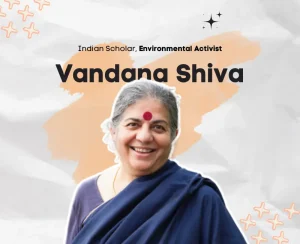
Vandana Shiva is an Indian scholar, food sovereignty advocate, and environmental activist. She is often called “Gandhi of grain” for her activism associated with the anti-GMO movement. In 1991, she founded Navdanya, a network dedicated to preserving native seeds and promoting organic farming practices across India.
Shiva’s work centers on the idea that seeds are the foundation of life and should remain in the hands of farmers rather than multinational corporations. She has campaigned against GM crops and harmful industrial farming that threaten biodiversity. Through Navdanya, she has been helping farmers save seeds, use fewer chemicals, and grow food sustainably.
Beyond agriculture, Vandana Shiva is a global voice for environmental justice. She speaks about the connections between climate change, water scarcity, deforestation, and social inequality, emphasizing that protecting the planet is inseparable from protecting human rights. Her books, lectures, and campaigns influence policies in India and inspire environmental movements worldwide.
Dr. Purnima Devi Barman – Greater Adjutant Protector
Dr. Purnima Devi Barman is an Indian conservationist renowned for her work in protecting the Greater Adjutant Stork, a critically endangered bird found in Assam. These storks, once abundant, faced severe population decline due to habitat loss, hunting, and urbanization. Recognizing the urgent need to act, Dr. Barman dedicated herself to saving this unique species while also involving local communities in conservation efforts.
Barman began working with greater adjutants during her PhD in Assam. She led campaigns using local traditions, street plays, festivals, and celebrity support to raise awareness about protecting these birds. She involves children, offers scholarships to families protecting nesting trees, and collaborates with government officials and local authorities to promote and support conservation efforts.
Barman also founded the Hargila Army, an all-female grassroots group with over 10,000 members, to protect greater adjutants and empower local women. The team protects stork nesting sites, rescues and rehabilitates injured nestlings, and educates people. Her efforts have increased the local bird population from 28 to 200 nests.
Ridhima Pandey – The Young Climate Activist
Ridhima Pandey is one of India’s youngest climate activists, known for her efforts to hold governments accountable for environmental protection. At just nine years old, she filed a case against the Indian government for failing to implement climate action policies, demanding stricter measures to combat climate change.
Pandey requested the Government to develop a plan to lower carbon emissions and combat climate change across the country, including reducing reliance on fossil fuels. In 2019, 11-year-old Ridhima Pandey led a climate strike in Dehradun and also urged Prime Minister Modi to stop tree felling in Mumbai’s Aarey Forest. In 2020, she wrote to him again, calling for urgent action on air pollution in major cities.
Ridhima’s work extends beyond legal action. She actively participates in climate conferences, including UN climate summits, where she raises her voice on issues like rising temperatures, pollution, and deforestation. She emphasizes that the decisions made today will impact the lives of future generations.
Almitra Patel – India’s Waste Warrior
Almitra Patel is a pioneering Indian environmentalist who has been at the forefront of anti-pollution activities. She was the first woman engineer from MIT and later became an environmental activist. Her passion for conservation and community welfare led her to take on multiple roles, including serving as a tree warden and advocating for environmental policies.
Since the 1970s, Almitra Patel has been active in civic and environmental causes, from saving Asiatic lions and Ulsoor Lake to promoting waste management and low-cost housing. In 1991, Almitra began exploring better ways to manage municipal waste and found that during visits to 80 Indian cities in 1994-1995 lacked even proper dumping facilities.
Her famous 1996 Public Interest Litigation in the Supreme Court, challenging open dumping, led to the creation of India’s Municipal Solid Waste Management Rules. Beyond policy work, Patel engages directly with communities to promote awareness about recycling, composting, and waste reduction.
Prasiddhi Singh – Climate Action Advocate
Prasiddhi Singh, one of India’s youngest environmental activists, has been making headlines for her extraordinary efforts to fight climate change and restore green spaces. At just seven years old, she founded the Prasiddhi Forest Foundation after witnessing the effects of deforestation and environmental degradation in her hometown in Tamil Nadu.
Since then, Prasiddhi has led initiatives to plant thousands of trees and create fourteen forests across India, especially in the Tamil region. Her work has paid special attention to restoring degraded areas in Tamil Nadu. In Puducherry, Prasiddhi has been actively involved in regular environmental initiatives, promoting greener and healthier surroundings.
Her activism has earned her national recognition, including being honored by the Government of India with the Pradhan Mantri Rashtriya Bal Puraskar, the country’s highest civilian award for children. But beyond accolades, the best thing is that she inspires others. Her speeches and campaigns show that environmental action is not reserved for adults or experts; even a child can lead change.
Radha Bahin Bhatt – Forest and Wildlife Defender
Radha Bahin Bhatt is a respected Gandhian social worker and environmentalist whose life’s work has been dedicated to empowering rural communities and protecting India’s natural resources. Bhatt has been a strong supporter of sustainable development for many years. She has worked closely with village communities to bring back traditional practices such as water harvesting, organic farming, and afforestation.
In the 1970s, as environmental concerns grew in the Himalayas, she joined the Chipko movement, where villagers, mainly women, hugged trees to stop them from being cut down. She also speaks out for sustainable development, opposes harmful mining and large dam projects, and works to protect local communities. Alongside her activism, she organizes tree-planting drives that help grow thousands of trees in the Pithoragarh and Almora districts.
Bhatt has worked hard to protect forests and rivers while keeping India’s tradition of living close to nature alive. For her efforts in social work, she was honored with the Padma Shri, India’s fourth-highest civilian award, in 2025.
Basanti Devi – Coastal Ecosystem Protector
Basanti Devi is a renowned Indian environmentalist from Uttarakhand, known for her efforts to protect rivers and forests in the fragile Himalayan ecosystem. She turned her attention to the environment after witnessing the deteriorating health of the Kosi River, a lifeline for villages in the Almora region.
Recognizing that the river’s depletion was directly linked to deforestation and unsustainable practices in surrounding areas, Basanti Devi mobilized local communities, especially women, to take action. She organized awareness campaigns, tree-planting drives, river rejuvenation projects, and community monitoring groups to restore forests and manage natural resources sustainably.
Basanti Devi worked with villagers and timber companies to stop cutting new trees and encouraged people to use only old wood for fuel. At present, she sets up local groups to protect the forest and gathers volunteers to fight fires. Her efforts have revived the area. Her work has earned her national recognition, including the Nari Shakti Puraskar, India’s highest civilian honor for women.
Conclusion
Rising temperatures, unpredictable rains, melting glaciers, and deforestation are clear warning signs of environmental change. However, India is lucky to have some amazing women environmentalists and biologists who are saving the planet in their own ways. We have Medha Patkar, Latika Nath, Neha Juneja, Vandana Shiva, Almitra Patel, Ridhima Pandey, and many more. These women are leading initiatives, raising awareness, filing PILs, and inspiring communities to take action for a sustainable future. Many of them work on ground level to restore ecosystems, protect wildlife, and engage local communities in sustainable practices.