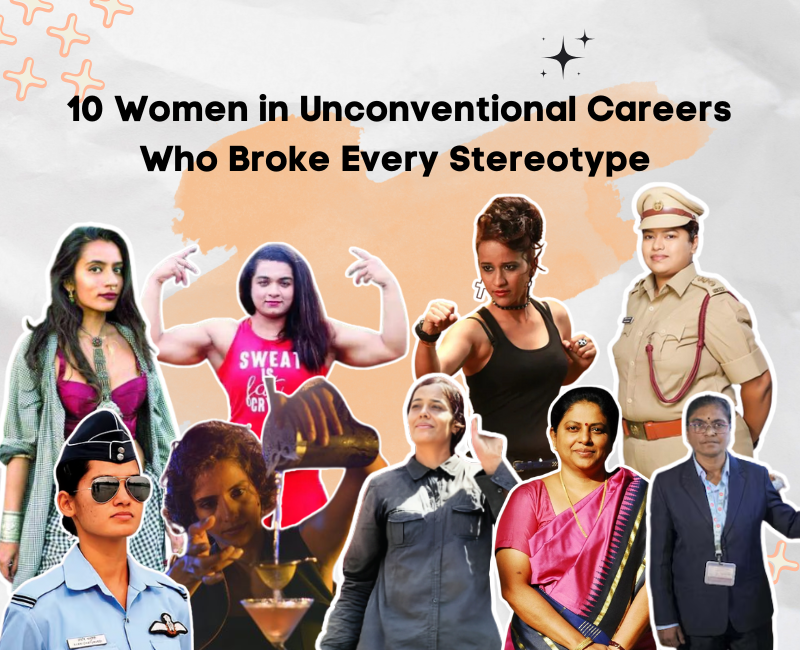
10 Women in Unconventional Careers Who Broke Every Stereotype
Date: January 16, 2026
For generations, women in India were expected to adhere to traditional roles, managing households or working in “safe” professions such as teaching or nursing. Careers in the military, law enforcement, aviation, or professional sports were considered out of reach.
But that mindset is collapsing. Today, Indian women are bus drivers, astronauts, martial arts instructors, corporate leaders, and even combat pilots. They are entering spaces once seen as untouchable and proving that skill, courage, and ambition have no gender.
A 2023 LinkedIn report indicates that 43% of India’s workforce is now female, with many opting for industries once dominated by men. Their progress is not just about personal success; it’s reshaping workplaces, inspiring younger generations, and redefining what’s possible.
This article highlights women who have broken stereotypes and carved out their place in unconventional careers, turning barriers into stepping stones and setting powerful examples for the future.
What Makes a Career “Unconventional” for Women in India?
The idea of “unconventional” comes from centuries of societal expectations. In traditional Indian society, women were expected to stick to domestic life or jobs that were seen as an extension of it. For example:
- Teaching was acceptable because it aligned with nurturing roles.
- Nursing was considered suitable because it symbolized the act of caregiving.
However, the moment women stepped into professions such as combat, law enforcement, aviation, or corporate leadership, eyebrows were raised. Even creative professions such as film production or costume design were once considered “unrealistic” or “inappropriate” for women.
Therefore, an unconventional job is about picking a path where women were told they don’t belong, not only about the profession itself. And every time a woman demonstrated otherwise, she made it possible for countless more to follow.
Indian Women Who Redefined Norms
Below are profiles of some of the most inspiring Indian women who broke stereotypes by excelling in unconventional careers. Each story is a reminder that gender should never dictate potential.
1. The Fighter Pilot – Avani Chaturvedi
Who She Is: Avani Chaturvedi is one of India’s first female fighter pilots. Along with her two colleagues, Mohana Singh Jitarwal and Bhawana Kanth, she was inducted into the Indian Air Force fighter squadron in 2016, a monumental decision that broke a decades-old gender barrier.
The Unconventional Path: For decades, combat roles in the Indian armed forces were deemed too physically and mentally demanding for women. The idea of a woman flying a supersonic fighter jet, navigating complex aerial maneuvers, and being ready for combat was a foreign concept.
Avani, however, proved that skill and courage know no bounds when it comes to gender. She underwent rigorous training, including intense simulated combat exercises and high-G force maneuvers, to earn her wings.
She has since flown frontline fighter jets, including the MiG-21 Bison, and has participated in joint international air exercises, showcasing her exceptional capabilities on the global stage.
Breaking the Stereotype: Avani’s story directly challenges the stereotype that women lack the physical & mental toughness for combat.
She, along with her peers, proved that with the proper training and opportunity, women are equally capable of serving on the front lines. Her success opened the door for more women to be inducted into combat roles, transforming the face of India’s defense forces.
2. The Firefighter – Harshini Kanhekar
Who She Is: Harshini Kanhekar is India’s first female firefighter. She shattered a deeply ingrained stereotype about the physical demands of firefighting, a profession that requires immense strength, endurance, and courage.
The Unconventional Path: In 2002, Harshini enrolled in the National Fire Service College in Nagpur, a college that had been exclusively male for over 100 years. She faced skepticism and resistance, but her determination never wavered.
Her training was no different from her male counterparts; she had to climb 70-foot ladders with heavy equipment, carry unconscious people, and endure intense heat and smoke.
She graduated with top honors and has since served with distinction, proving her mettle in real-life rescue operations.
Breaking the Stereotype: Harshini’s journey is a powerful testament to the fact that brute strength is not the only prerequisite for success. She demonstrated that intelligence, agility, and mental fortitude are equally, if not more, critical.
Her story paved the way for more women to join the fire service, inspiring a new generation to see beyond traditional gender roles.
3. The Train Driver – Surekha Yadav
Who She Is: Surekha Yadav is Asia’s first female train driver. Her career began in 1988, a time when the sight of a woman in the driver’s cabin of a train was unheard of.
The Unconventional Path: Surekha joined the Indian Railways as a trainee assistant driver and navigated a male-dominated environment with unwavering resolve.
She learned to operate complex machinery, understand intricate signaling systems, and handle the immense responsibility of transporting thousands of passengers safely and efficiently.
Her early years were filled with curiosity and doubt from passengers and colleagues alike, but her professionalism and skill quickly earned her respect.
Over her decades-long career, she has driven various types of trains, including the prestigious Deccan Queen Express and the Vande Bharat Express, and has trained countless others.
Breaking the Stereotype: Surekha’s journey dismantled the notion that women are not suited for roles that involve heavy machinery and technical expertise.
Her consistent, exemplary performance over the past three decades has made her a living legend and a symbol of what is possible when women are given the chance to prove themselves.
4. The Bartender – Ami Shroff
Who She Is: Ami Shroff is one of India’s most celebrated flair bartenders and a pioneer in the industry. Flair bartending involves a high-energy performance, where bartenders juggle, spin, and throw bottles and shakers in a theatrical display.
The Unconventional Path: The bartending industry, particularly in India, has long been a male bastion. Women who entered the field were often confined to serving roles, with flair bartending being an exclusive domain for men. Ami challenged this from the start.
She trained rigorously to master the art of flair, which requires precision, strength, and showmanship. She has competed in national and international competitions, where her unique style and skills have earned her global recognition.
Breaking the Stereotype: Ami’s success challenges the notion that the hospitality industry is unsuitable for women, particularly in physically demanding and high-visibility roles. She demonstrated that bartending is a skilled craft and a form of art, not just a service job.
Her presence has inspired many young women to enter the industry and pursue their passion for mixology and flair.
5. The Graffiti Artist – Shilo Shiv Suleman
Who She Is: Shilo Shiv Suleman is a celebrated Indian illustrator, visual artist, and a pioneer in the field of street art and graffiti. Her work frequently explores themes of women’s empowerment, social justice, and ecological harmony.
The Unconventional Path: The world of street art and graffiti is predominantly male-dominated globally. The profession is often associated with late-night clandestine work and physically demanding conditions.
Shilo, however, has used this medium to create vibrant and meaningful murals that have transformed public spaces and sparked important conversations.
Her work with the “Fearless Collective” uses art as a tool for social change, collaborating with communities to paint murals that tell stories of resilience and hope.
Breaking the Stereotype: Shilo’s career challenges the idea that women’s art should be confined to galleries or traditional mediums.
She has proven that street art can be a powerful vehicle for a feminine perspective, using her work to reclaim public spaces and challenge patriarchal norms. Her bold, colorful murals are a testament to her creative strength and social activism.
6. The Truck Driver – Yogita Raghuvanshi
Who She Is: Yogita Raghuvanshi is one of India’s few female truck drivers. She became a professional long-haul truck driver in the 1990s, a time when the profession was considered not only male-dominated but also highly unsafe for women.
The Unconventional Path: After her husband passed away, Yogita, a law graduate, found herself in a difficult position to provide for her two children. Finding that no other profession offered the financial independence she needed, she took to the road, literally.
She learned to drive a truck and navigate the treacherous highways of India, often covering thousands of kilometers across different states.
She faced immense social prejudice, safety concerns, and physical hardship, but persevered with a singular focus on her children’s future.
Breaking the Stereotype: Yogita’s story is a powerful narrative against the stereotype that women are physically incapable of handling heavy machinery and the rigors of life on the road.
Her courage in the face of adversity and her determination to provide for her family make her an icon of resilience and self-reliance.
She demonstrated that a mother’s love knows no conventional boundaries and that a woman can thrive in a profession long considered exclusively for men.
7. The Astronomer – Dr. Tessy Thomas
Who She Is: Dr. Tessy Thomas is a prominent Indian scientist and the first woman to head an Indian missile project. She is known as the “Missile Woman of India” for her significant contributions to the development of the Agni series of ballistic missiles.
The Unconventional Path: The field of aerospace and missile technology is highly complex and male-dominated globally. Tessy, however, excelled in this challenging domain.
She joined the Defence Research & Development Organisation (DRDO) and became a key scientist in the development of India’s long-range nuclear-capable missiles.
Her work required a rare combination of theoretical expertise, practical engineering skills, and a strategic vision. She led a team of thousands of scientists and engineers, navigating high-pressure situations with calm resolve.
Breaking the Stereotype: Dr. Tessy Thomas’s career completely shatters the stereotype that women are not suited for highly technical, high-stakes fields.
She proved that intellect and leadership are gender-neutral. Her achievements encouraged many young girls to pursue careers in science, technology, engineering, and mathematics (STEM), and significantly enhanced India’s defense capabilities.
8. The Bodybuilder – Bhumika Sharma
Who She Is: Bhumika Sharma is an Indian bodybuilder who won the Miss World title in the Bodybuilding Championship in Venice in 2017. Her journey into this field challenged deep-seated cultural norms about female body image and strength.
The Unconventional Path: In India, a woman’s physique is often associated with delicacy and a certain conventional standard of beauty. The idea of a woman building a highly muscular physique is met with skepticism and criticism.
Bhumika, however, was passionate about the sport. She dedicated herself to a strict training regimen & a strict diet, pushing her body to its physical limits.
She faced backlash from her community and even her family, who found her career choice to be too unconventional.
She persevered and, with her international win, brought recognition to the sport and changed the conversation around female strength in India.
Breaking the Stereotype: Bhumika’s success directly challenges the aesthetic stereotype of a woman. She proved that strength is beautiful and that a woman’s body is a tool for power and performance, not just an object to be admired.
Her journey has inspired a new generation of women to enter the world of fitness and bodybuilding and to pursue their goals without fear of judgment.
9. The Professional Gamer – Sayonara “Rebel” Devi
Who She Is: Sayonara Devi, also known as “Rebel,” is a professional e-sports athlete from India. She is a pioneer in the still-nascent but rapidly growing world of professional gaming.
The Unconventional Path: E-sports, or competitive video gaming, has traditionally been seen as a male-dominated hobby and career. Women who enter the field often face immense online harassment and discrimination.
Sayonara, however, has carved a niche for herself in this challenging environment. She has competed in national and international tournaments, building a reputation for her skill and strategic gameplay.
She has become a role model for aspiring female gamers, showing them that they can not only participate but also excel in this field.
Breaking the Stereotype: Sayonara’s career challenges the stereotype that gaming is an exclusively male activity. She has demonstrated that success in e-sports is primarily determined by talent and dedication, rather than gender.
Her presence in the professional gaming community has helped foster a more inclusive environment and brought attention to the need for greater diversity in esports.
10. The Stuntwoman – Geeta Tandon
Who She Is: Geeta Tandon is one of India’s most accomplished stuntwomen. She has performed high-risk stunts in over 100 films, often as the body double for leading actresses.
The Unconventional Path: Geeta’s journey into the film industry was a remarkable one. As a young woman, she escaped an abusive marriage and found herself in a desperate situation with two children to support.
She discovered the world of stunt performing, a profession that requires immense bravery, physical endurance, and a complete disregard for fear. She trained herself in various disciplines, including fire stunts, high falls, and car chases, and quickly made a name for herself in the industry.
Breaking the Stereotype: Geeta’s career shatters multiple stereotypes. It challenges the notion that stunt work is too dangerous for women and that women cannot perform the physically demanding roles that men do.
More importantly, her personal story is a testament to resilience and empowerment, showing that a woman can rebuild her life and find strength and purpose in the most unexpected of places. She is not just a stuntwoman; she is a survivor who found her true calling by confronting fear head-on.
Conclusion
Stereotypes are designed to be challenged, as demonstrated by Seema Rao’s involvement in military training and Kalpana Chawla’s ascent to fame.
The future of India will be more promising, inventive, and inclusive because of the women who dared to pursue unorthodox careers. We learn from their lives that courage and brilliance are genderless.