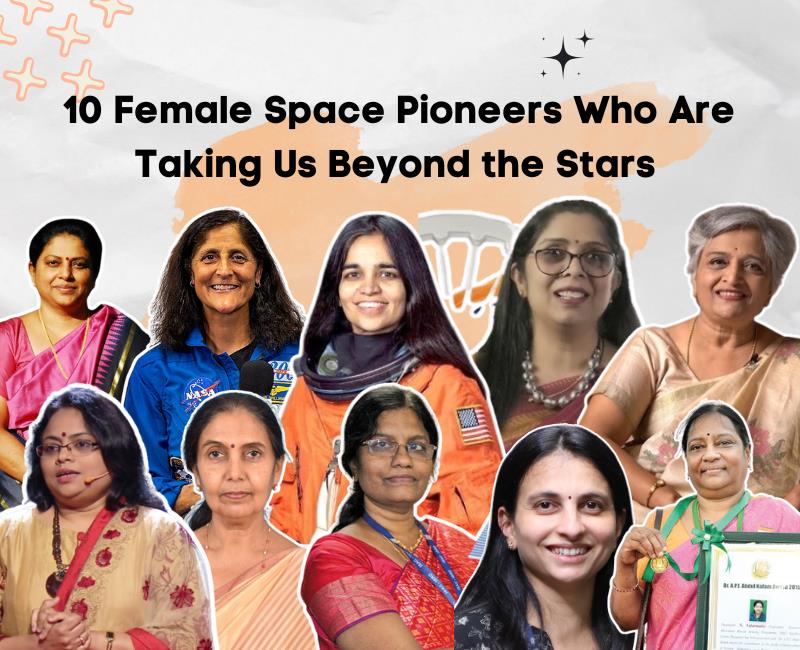
10 Female Space Pioneers Who Are Taking Us Beyond the Stars
Date: February 26, 2026
Space has always been seen as a man’s frontier. More than 500 men have traveled beyond Earth, but fewer than 70 women have achieved the same feat. Yet, every time women have entered the field, they’ve redefined what was possible, from Valentina Tereshkova, the first woman in space in 1963, to the first all-female spacewalk in 2019.
India has its own trailblazers. Kalpana Chawla became the 1st woman of Indian origin in space, and Sunita Williams logged over 322 days in orbit with multiple spacewalks. At ISRO, women like Ritu Karidhal, known as the “Rocket Woman of India,” and M. Vanitha, project director of Chandrayaan-2, have led missions that put India on the global space map.
These stories aren’t just milestones in spaceflight; they’re proof that Indian women are at the forefront of shaping humanity’s journey to the stars.
1. Kalpana Chawla
No discussion of Indian women in space is complete without honoring Kalpana Chawla. Born in Karnal, India, in 1962, Chawla’s fascination with flight began at an early age. She would often gaze at the night sky, captivated by the stars and the universe’s mysteries.
This childhood curiosity blossomed into an unwavering ambition, setting her on a path that would make her the first woman of Indian origin to travel to space.
Chawla pursued a bachelor’s degree in aeronautical engineering from Punjab Engineering College, a time when few women chose this field.
She pursued further education in the US, graduating with a Ph.D. from the University of Colorado at Boulder and a master’s degree in aerospace engineering from the University of Texas at Arlington. When NASA chose her as an astronaut candidate in 1995, her lifetime goal came true.
Her legacy was solidified in 1997 when she made her first voyage on board the Space Shuttle Columbia (STS-87). She was instrumental in deploying the Spartan Satellite and carrying out a number of scientific experiments as a mission specialist & robotic arm operator.
During this mission, she logged more than 372 hours in space, fulfilling a dream that had taken root in her childhood backyard.
Kalpana Chawla’s second mission, STS-107 in 2003, was a dedicated science and research flight. The crew conducted over 80 experiments, focusing on a range of topics including microgravity and materials science, as well as prostate cancer research.
Tragically, on 1st February, 2003, the Space Shuttle Columbia broken up upon re-entry into the Earth’s atmosphere, claiming the lives of all 7 crew members, including Chawla.
Her untimely death was a profound loss, but her legacy endures. Kalpana Chawla’s journey, from a small town in India to the vastness of space, is a powerful narrative of perseverance and passion.
Her story continues to inspire millions of young girls around the world to pursue their dreams, proving that with determination, the sky is not the limit, it’s just the beginning.
2. Sunita Williams
Following in Chawla’s footsteps, Sunita Williams became the second woman of Indian ancestry to go to space.
Born in Ohio to an Indian-Slovenian family, Williams’s career is a remarkable chronicle of breaking records and demonstrating exceptional endurance. She was chosen as a NASA astronaut in 1998 and was a successful helicopter pilot and U.S. Navy veteran.
Williams’ perseverance is demonstrated by the fact that she has completed two missions and 322 days in space overall. When she headed the Space Shuttle Discovery in 2006, she made her first voyage to the International Space Station (ISS).
During her time on Expeditions 14 and 15, she set a new record for the longest single spaceflight by a woman at the time, at 195 days. But her most famous achievement from this mission was running the first-ever marathon in space. Tethered to a treadmill, she completed the Boston Marathon in 4 hours and 24 minutes, a truly cosmic display of human resolve.
Williams’s expertise extends to spacewalks, also known as Extra-Vehicular Activities (EVAs). She has completed a total of seven spacewalks, accumulating over 50 hours outside the space station, a record for a female astronaut for many years.
Her work has included critical maintenance tasks, such as installing a new component to the station’s cooling system and helping to re-route electrical power.
Her most recent mission, a test flight of Boeing’s Starliner spacecraft, showcased her continued dedication to human spaceflight.
Williams’s journey represents a bridge between two worlds: her Indian heritage and her American identity. Her career highlights the global, collaborative nature of modern space exploration. She is a symbol of a new era of astronauts who are not only scientists and pilots but also exceptional communicators and inspirational figures.
3. Ritu Karidhal Srivastava
While Kalpana Chawla and Sunita Williams captured the public imagination as astronauts, a new generation of pioneers at the Indian Space Research Organisation (ISRO) has been making equally profound contributions from the ground. Among them, Ritu Karidhal Srivastava stands out as a leading light, earning the moniker “Rocket Woman of India.”
An aerospace engineer and scientist, Karidhal has been at the forefront of some of India’s most significant space endeavors.
Her journey began at the University of Lucknow, where she earned a B.Sc. and M.Sc. in Physics, followed by an M.Tech. in Aerospace Engineering from the Indian Institute of Science, Bangalore. Joining ISRO in 1997, she has since become a key figure in mission planning and execution.
Karidhal’s most notable contribution came during the Mars Orbiter Mission (Mangalyaan). As the Deputy Operations Director, she was instrumental in conceptualizing and executing the craft’s autonomous systems, allowing it to navigate and respond to malfunctions independently in the vast emptiness of space.
The mission’s success, achieved at a fraction of the cost of its Western counterparts, was a source of national pride and established India as a major player in interplanetary exploration.
Her leadership continued on the Chandrayaan-2 mission, where she served as the Mission Director. While the mission’s lander had a partial failure, the orbi
4. Muthayya Vanitha
When ISRO embarked on its second lunar mission, Chandrayaan-2, it was led by a team of women, with Muthayya Vanitha at the helm as the Project Director. Vanitha, an electronics systems engineer with over three decades of experience at ISRO, made history as the first woman to lead an interplanetary mission in India.
Her journey at ISRO began as a junior engineer, where she worked on hardware and design. Over the years, her exceptional problem-solving and team management skills propelled her to leadership roles. Her previous work on satellites, including Cartosat-1, Oceansat-2, and the Mars Orbiter Mission, provided the perfect training ground for her monumental task with Chandrayaan-2.
Taking on the role of Project Director was not an easy decision for Vanitha. As she recalled in interviews, the former Chandrayaan-1 Project Director, Mylswamy Annadurai, had to persuade her to take on the responsibility for nearly a year.
Her expertise in data handling and her meticulous approach to engineering, however, made her the ideal candidate. Her responsibilities included overseeing every aspect of the mission, from the design and development of all systems to its eventual launch.
The successful launch of Chandrayaan-2 in July 2019 was a moment of immense triumph for her and her team. While the mission’s lander component, the Vikram lander, encountered a soft-landing anomaly, the orbiter element continues to function flawlessly, orbiting the Moon and sending back invaluable data.
Vanitha’s leadership on this project was a landmark moment, showcasing that women are not only capable of participating in high-stakes space missions but are also essential to their leadership and success.
5. V. R. Lalithambika
As India prepares to launch its 1st crewed mission, Gaganyaan, a seasoned and brilliant mind is at the forefront: V. R. Lalithambika. As the Director of the Human Spaceflight Programme, she is entrusted with the monumental task of sending Indian astronauts into space.
Lalithambika has worked for ISRO for more than thirty years and is an expert in Advanced Launch Vehicle Technology. Significant contributions to the creation of ISRO’s most potent rockets, such as the Polar Satellite Launch Vehicle (PSLV) & the Geosynchronous Satellite Launch Vehicle (GSLV), have distinguished her career.
She has been involved in more than 100 space missions, a feat that speaks to her extensive expertise and technical acumen.
Her work involves a deep understanding of complex control and guidance systems, which are crucial for the stability and accuracy of a rocket’s trajectory.
Her move to lead the Gaganyaan program is a natural progression, as it brings her expertise in launch vehicle technology to bear on the ultimate challenge: ensuring the safety of human lives in space.
Her role involves meticulous planning, rigorous testing, and the integration of multiple complex systems, all of which are vital to the success of a mission of this magnitude.
In 2023, France honored her with its highest civilian award, the Légion d’Honneur, for her contributions to India-France space cooperation.
This recognition highlights her status not only as a national hero but as a global leader in the field of space engineering.
V. R. Lalithambika’s work is laying the foundation for a new era of Indian space exploration, one where India will not just be a satellite launcher but a participant in the exclusive club of nations capable of human spaceflight.
6. Tessy Thomas
While not directly involved with ISRO’s satellite missions, Dr. Tessy Thomas is a pivotal figure in India’s broader aerospace and defense landscape. Known as the “Missile Woman of India,” she is a distinguished scientist at the Defence Research and Development Organisation (DRDO) and the first woman to lead a missile project in India.
Her work on the Agni series of ballistic missiles has been instrumental in enhancing India’s defense capabilities. She was in charge of designing and creating guiding systems that allowed the Agni-IV and later the long-range Agni-V missiles to endure high temperatures and speeds when they re-entered the atmosphere in her capacity as Project Director.
Her contributions have enabled India to become one of the few nations with the capability to develop such advanced technology.
Dr. Thomas’s story is a powerful reminder that the fields of aerospace and defense are intertwined and that women are making significant contributions to both.
Her journey from a small town in Kerala to the highest echelons of Indian defense science has inspired countless women to pursue careers in a field that was once considered exclusively for men. She has proven that gender is no barrier to excellence in science and engineering.
7. Other Stellar Contributors
The success of ISRO’s missions is a collective effort, and countless other women have contributed their brilliance behind the scenes.
- Nandini Harinath, a rocket scientist, was one of the key figures in the Mars Orbiter Mission. As a Deputy Operations Director, her work in mission design and spacecraft operations was vital.
- Anuradha T.K. holds the distinction of being the 1st woman to be a Satellite Project Director at ISRO. She led the successful launch of communication satellites and has been a strong advocate for gender equality in the STEM field.
- Minal Rohit, a systems engineer on the Mangalyaan mission, played a crucial role in integrating the various components of the spacecraft. Her work ensured the seamless operation of the mission, demonstrating the critical role of systems engineering in space exploration.
- N. Valarmathi was the project director for RISAT-1, India’s first indigenous radar imaging satellite. Her leadership on this project was a significant achievement, cementing her legacy as a pioneer in remote sensing and satellite technology.
Conclusion
Indian women are demonstrating that the sky is only the beginning, as seen by Ritu Karidhal’s leadership in Chandrayaan and Kalpana Chawla’s courageous voyage.
The next generation of young girls in India is watching, learning, and dreaming. And thanks to these pioneers, they now know that space is not a distant dream but a reachable horizon.
The real question is no longer if Indian women will shape the future of space exploration; it’s how far they’ll go.